

You wash your hair in the morning, feel the scalp tighten as it dries, and notice flakes on your shoulders by afternoon. Perhaps the roots already feel oily, while the skin underneath still itches. Scratching removes a few loose flakes, but it can also disturb the scalp and restart the same uncomfortable cycle.
That pattern doesn't always mean the scalp needs more moisture. Dandruff often involves adherent scale, meaning compacted dead skin cells that cling to the scalp instead of shedding and rinsing away easily. Oil, sweat, styling products, and an active scalp condition can make that buildup more noticeable.
Dandruff affects approximately 50% of the general adult population worldwide, which helps explain why salicylic acid anti-dandruff shampoo has remained a familiar category in mass-market scalp care. Clinical research has tested salicylic-acid shampoos for dandruff and seborrhoeic dermatitis, including formulas that also contain antifungal ingredients, with improvements in symptoms and itching reported during treatment and follow-up (clinical review and trial data).
The useful way to think about salicylic acid is not as a complete cure in a bottle. It acts mainly as a scale-loosening step. It can make stubborn flakes easier to detach, while hydration, conditioning, barrier support, and, when appropriate, antifungal or anti-inflammatory care address the rest of the scalp environment.
This guide separates those jobs clearly. It explains how salicylic acid works, how 2% and 3% formulas differ, when dandruff care needs a different approach from psoriasis-prone scalp care, and how to build a routine that removes buildup without leaving the scalp raw. If you're pregnant and considering oil-based comfort measures for a dry scalp, review a resource such as this guide to safe coconut oil for pregnancy before adding a new ingredient to your routine.
Table of Contents
- Introduction Why Flakes Keep Coming Back
- How Salicylic Acid Loosens Flakes and Scales
- Choosing the Right Strength and Formula
- Who Should Use Salicylic Acid Shampoo and Who Should Pause
- How to Use Salicylic Acid Shampoo Without Dryness or Irritation
- Pairing Salicylic Acid With Peat Mud and Other Actives
- Building a Calmer Scalp Routine That Lasts
Introduction Why Flakes Keep Coming Back
A person with recurring flakes may use a stronger shampoo, scrub harder, or wash more often. The scalp can look cleaner for a short time, yet the itch returns and the flakes seem to reappear almost immediately. That doesn't necessarily mean the shampoo failed. It may mean the visible scale was removed without addressing the conditions that help it accumulate again.
The scalp is skin, but it deals with a busy mix of sebum, sweat, friction, hair products, heat, and regular shedding. When dead cells stick together or remain attached to the scalp, ordinary washing may not release them completely. A flake that looks dry and white from a distance can still be firmly attached at its base.
The flake is often attached, not simply loose
This distinction matters because different ingredients solve different problems. A conditioner can improve softness and reduce the rough feeling along the hair shaft. A gentle cleanser can remove oil and residue. An antifungal active may be relevant when dandruff or seborrhoeic dermatitis involves microbial imbalance. None of those actions is identical to loosening compacted scale.
Salicylic acid belongs to the keratolytic family. In simple terms, it helps soften and separate the buildup that makes flakes cling. Once the scale is less compact, water and gentle cleansing can carry it away more effectively.
The practical idea: remove attached scale gently, then support the scalp so it doesn't feel stripped after cleansing.
The scalp also needs a routine that matches the problem. Mild, occasional flaking may call for a lower-strength formula and careful maintenance. Heavy, adherent scaling may need a more targeted product, but a stronger formula can be uncomfortable if the scalp barrier is already irritated.
What a successful routine should feel like
Progress isn't only a visibly cleaner scalp after one wash. Look for a gradual pattern of less attached flaking, less urge to scratch, improved comfort, and better tolerance between washes. If the scalp becomes increasingly sore, burning, tight, or unusually dry, more exfoliation isn't automatically the answer.
The sections ahead treat salicylic acid as one part of scalp care. It can prepare the surface by loosening scale, while conditioning and barrier-friendly habits help make the result more comfortable and sustainable.
How Salicylic Acid Loosens Flakes and Scales
The word keratolytic sounds technical, but the underlying idea is straightforward. “Keratin” refers to the structural protein found in the outer layer of skin, while “lysis” suggests loosening or breaking apart. A keratolytic ingredient helps reduce the cohesion of compacted dead skin so it can separate more easily.
Think of a thin layer of wallpaper that has become stuck to a wall. Pulling at a dry corner may tear the wallpaper and scratch the surface underneath. Dampening and loosening the adhesive first makes removal gentler and more complete. Salicylic acid performs a comparable preparatory role on adherent scalp scale. It doesn't add water like a moisturizer, and it doesn't perform the same task as an antifungal active.
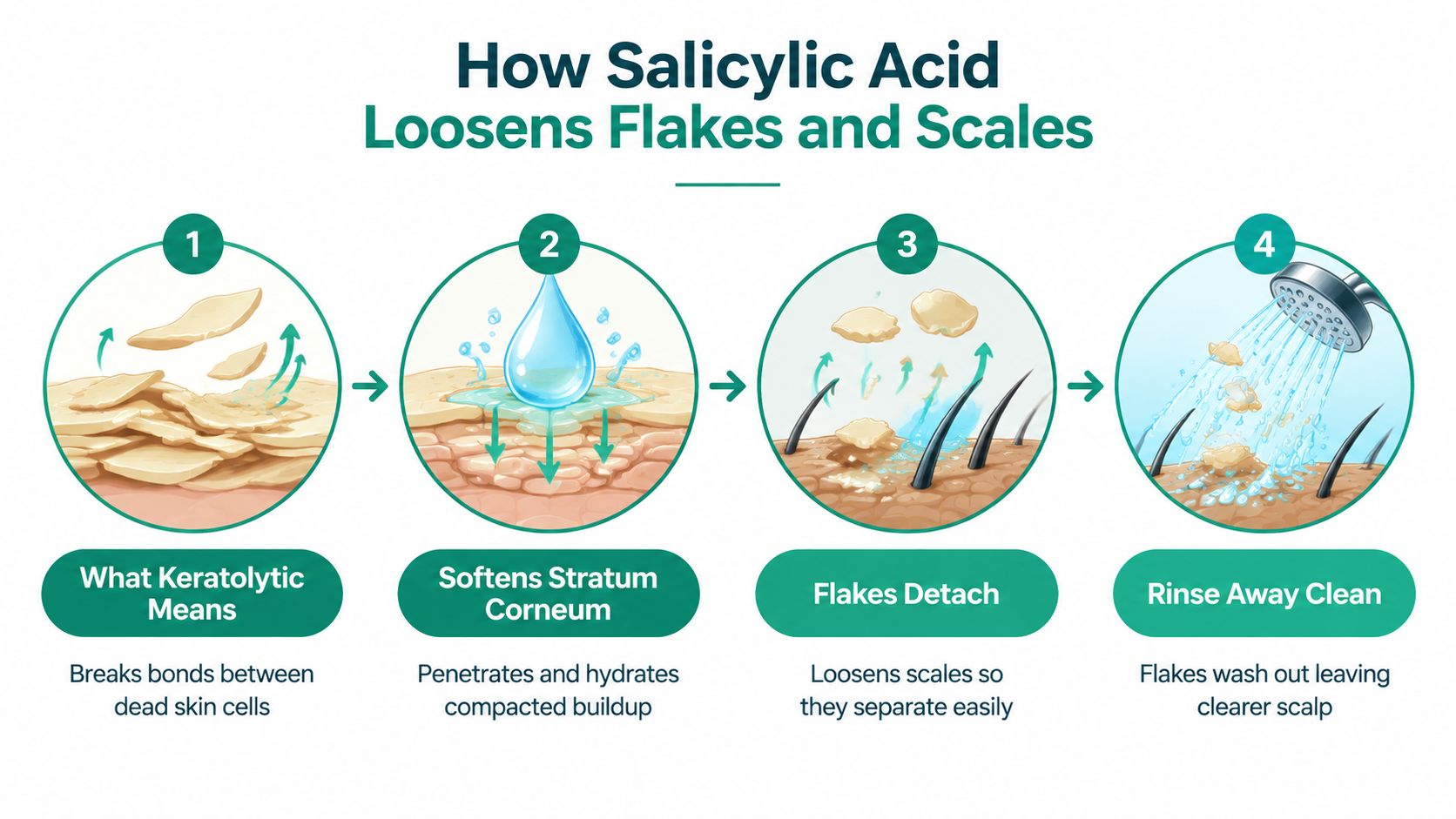
From compact buildup to easier rinsing
The process can be understood in four connected stages:
- Compacted cells remain attached. The outer scalp layer can hold together as visible scale rather than shedding as tiny, unnoticed particles.
- Salicylic acid softens the buildup. Its keratolytic action helps loosen the compacted outer layer.
- The scale separates more readily. Flakes can lift from the scalp with less need for scraping or aggressive fingernail scratching.
- Cleansing carries the loosened material away. Water and a suitable shampoo can rinse the detached scale from the scalp and hair.
Clinical work supports this scale-focused role. In one controlled study, a shampoo containing 2% salicylic acid was used twice weekly for 5 weeks in 48 adults with moderate to severe scaling. The salicylic-acid formula worked better when combined with sulfur, producing earlier and greater reductions in scaling and corneocyte counts than salicylic acid alone or the vehicle (controlled salicylic-acid shampoo research).
That finding also explains why the percentage printed on a label isn't the whole story. The shampoo's vehicle, supporting ingredients, contact with the scalp, and ability to rinse clean all influence how the keratolytic action feels in practice.
What salicylic acid doesn't do by itself
Salicylic acid can improve the physical removal of flakes, but flake removal and inflammation control are different tasks. A red, greasy, persistently itchy scalp may need an antifungal or anti-inflammatory strategy alongside scale loosening. A psoriasis-prone scalp may have thick plaques that require a condition-specific plan rather than repeated exfoliation alone.
The same principle applies to comfort. Once compacted scale has been removed, the scalp may still need gentle cleansing, conditioning around the hair, and a routine that protects the skin barrier. Overworking the surface can make a person feel temporarily “clean” while increasing tightness and irritation.
For people looking for a more thorough approach during periods of noticeable buildup, the PsoriAid Moderate Routine combines a shampoo containing Nordic peat mud and 3% salicylic acid with a conditioner containing Nordic peat, jojoba oil, and panthenol. Its listed shampoo directions are to massage gently, leave the lather for 2–3 minutes, and use it 2–3 times per week.
Choosing the Right Strength and Formula
The most common comparison is simple: should you choose 2% or 3% salicylic acid? FDA OTC dandruff and seborrhoeic dermatitis regulation includes salicylic acid products, with 2% commonly used in monographed anti-dandruff shampoos. Clinical studies have also evaluated 3% formulas, including a randomized trial involving 154 subjects, among them people with dandruff and seborrhoeic dermatitis (FDA rulemaking history).
A practical interpretation is that 2% often suits routine flake control, while 3% may be considered when the scale is heavier or more adherent. That isn't a universal rule, and a higher concentration isn't automatically better for a sensitive or already-irritated scalp.
| Formula Type | Best For | What to Expect |
|---|---|---|
| 2% salicylic acid alone | Routine visible flake control and mild buildup | A straightforward keratolytic option. Tolerance depends on the vehicle and washing habits. |
| 3% salicylic acid alone | More noticeable or adherent scale | A stronger scale-loosening approach that may feel more drying if overused. |
| 2%–3% with supportive co-ingredients | Buildup alongside concerns about comfort or ongoing scalp symptoms | The vehicle, co-actives, and contact time may improve practical performance beyond percentage alone. |
Why the formula can matter more than the label number
Comparative research found that a shampoo containing 5% sulfur plus 3% salicylic acid produced significantly greater improvement in adherent dandruff scores after two applications within six days than a formula containing 2% sulfur plus 2% salicylic acid. Separate formulation research reported dandruff reduction in all subjects using 2% salicylic acid plus 0.5% propanediol caprylate, compared with 91% for a 3% salicylic-acid-only comparator (formulation comparison data).
Those results don't mean one formula will suit every person. They show why percentage alone is a poor shortcut. A well-designed vehicle may improve spreading, penetration, contact, rinsing, or tolerance. Sulfur and other co-actives can also change the formula's purpose.
Label-reading rule: compare the active percentage, supporting ingredients, directions, and expected use pattern together.
That same discipline helps with any ingredient-led purchase. A practical choosing quality supplements guide offers a useful reminder to assess the whole label rather than focusing on one headline ingredient. For dandruff products, also check whether the formula is intended for regular maintenance, heavier scale, or a specific scalp condition.
If redness, greasiness, or persistent itching dominates the picture, a salicylic acid shampoo may be only one part of care. Guidance on medicated shampoos for seborrheic dermatitis can help you compare the role of keratolytic and antifungal approaches without treating every flake as the same condition.
Who Should Use Salicylic Acid Shampoo and Who Should Pause
A flake is a visible sign, not a diagnosis. Classic dandruff, seborrhoeic dermatitis, and scalp psoriasis can overlap in appearance, but they don't always need the same routine. Salicylic acid may be useful in each context for scale, yet its role changes depending on the redness, oiliness, thickness, and sensitivity involved.
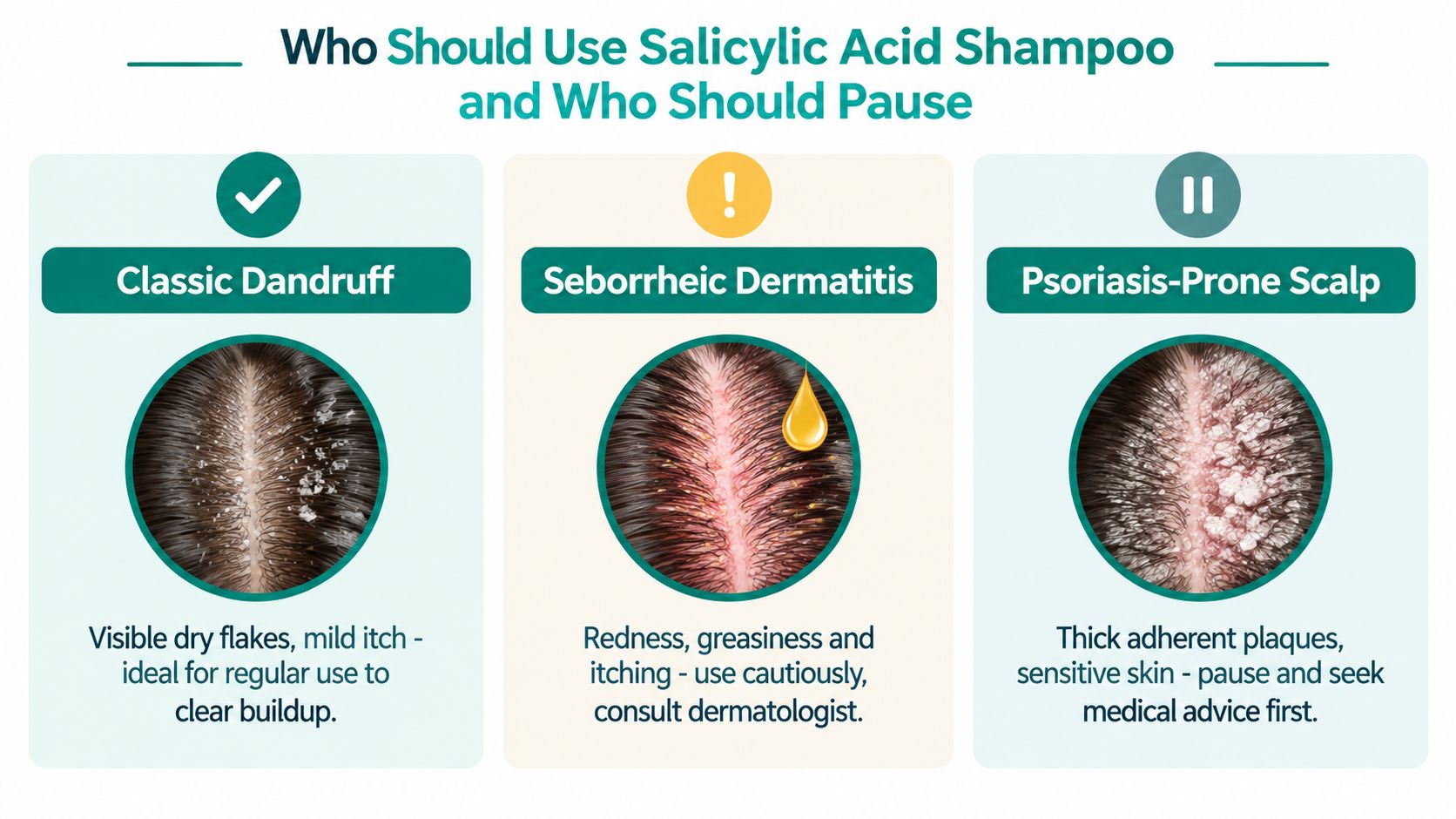
Classic dandruff
Classic dandruff often presents as visible flakes with some itch, without a dominant pattern of intense redness, greasy scale, or thick plaques. In this situation, salicylic acid can be a sensible primary tool because it targets the physical buildup that makes flakes obvious.
Use it as a controlled cleanser rather than a scalp scrub. If the scalp feels comfortable and the flakes become easier to rinse away, the formula may be doing the job intended for it.
Seborrhoeic dermatitis
Seborrhoeic dermatitis can involve redness, itching, greasiness, and scaling. Clinical testing of a shampoo containing 3% salicylic acid with 1.5% ciclopirox olamine found significant improvement in dandruff and seborrhoeic dermatitis symptoms by treatment day 29, with follow-up at day 43. The salicylic-acid-containing formula also showed a significant reduction in itching that ketoconazole shampoo did not show in that trial (randomized clinical study).
The important distinction is that the salicylic acid helped with scale and itching within a combination formula. When inflammation, greasiness, or recurring symptoms are prominent, an antifungal or other medically appropriate active may be needed rather than relying on salicylic acid alone.
Psoriasis-prone scalp
Psoriasis-prone scalp can produce thick, adherent plaques and irritation. A keratolytic shampoo may help lift scale, but thick plaques and sensitive skin deserve more caution. A separate randomized study in mild-to-moderate scalp psoriasis found that a keratolytic and hydrating shampoo improved scalp psoriasis scores and irritation, which reinforces the value of pairing scale removal with hydration rather than treating exfoliation as the entire plan (recent clinical review and evidence).
Pause self-directed escalation and seek medical guidance if the scalp is painful, bleeding, intensely inflamed, rapidly worsening, or difficult to distinguish from another condition. A dermatologist can help decide whether salicylic acid should be combined with psoriasis-specific or anti-inflammatory care.
Decision guide: If scale is the main problem, salicylic acid may lead. If inflammation or thick plaques lead, scale loosening should usually sit inside a broader plan.
How to Use Salicylic Acid Shampoo Without Dryness or Irritation
A salicylic acid anti-dandruff shampoo works best when you give it enough scalp contact to loosen scale, but not so much exposure that the skin becomes uncomfortable. The aim is controlled contact, gentle handling, thorough rinsing, and recovery between active washes.
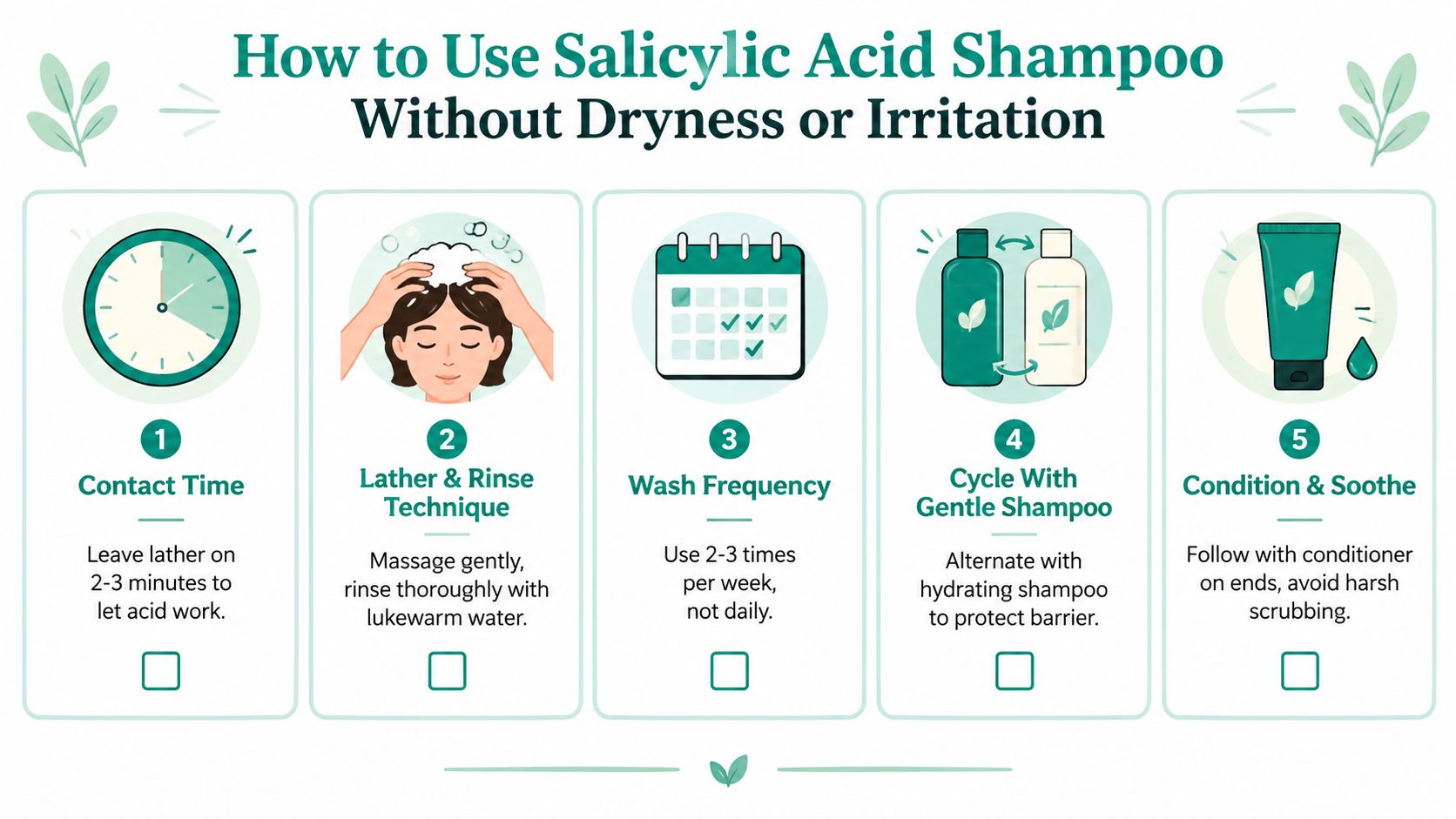
A scalp-friendly wash
- Wet the scalp fully. Water helps distribute the shampoo across the roots and reduces the temptation to use friction to spread it.
- Apply to the scalp, not just the hair lengths. Use the pads of your fingers and work across the areas with visible scale.
- Massage gently. Fingernails can scratch irritated skin and make the scalp feel worse.
- Allow brief contact. Product directions may specify a short lathering period. For the PsoriAid+ shampoo routine described above, the listed contact time is 2–3 minutes.
- Rinse thoroughly with lukewarm water. Residue can add discomfort, while very hot water may leave a reactive scalp feeling tighter.
- Condition the hair lengths. Keep conditioner focused on the mid-lengths and ends if the roots become oily easily.
The listed schedule for the PsoriAid Moderate Routine is 2–3 times per week, but your scalp's response matters. Use the product label as the primary guide, especially because formulas differ in strength and supporting ingredients.
How to spot poor tolerance
Dryness from over-exfoliation often feels like increasing tightness, burning, stinging, tenderness, or fine irritation after washing. Ongoing scalp activity may look more like persistent greasy scale, redness, itching, or plaques that don't settle despite careful use. These patterns can overlap, so worsening symptoms shouldn't be answered by automatically increasing frequency.
Alternate active washes with a gentle, hydrating shampoo when your scalp needs recovery. Keep the rest of the routine uncomplicated while you assess tolerance. Don't add a scrub, strong fragrance, or several exfoliating products at the same time, because you won't know which step caused irritation.
A staged routine can also make sense for stubborn scale. Recent clinical work has examined salicylic acid with piroctone olamine in a pre-gel and cleanser approach for moderate-to-severe scalp seborrhoeic dermatitis, reflecting interest in using a preparatory step before cleansing (clinical report on a staged scalp routine).
The video below provides another visual reference for gentle application technique.
Pairing Salicylic Acid With Peat Mud and Other Actives
Salicylic acid handles one central task, loosening compact scale. A broader routine can then add ingredients that support cleansing, comfort, hydration, or control of the factors associated with recurring dandruff and seborrhoeic dermatitis.
Nordic peat mud is used in some dermocosmetic formulas as a supportive cleansing and conditioning component. Sphagnum Botanicals describes its peat-based approach in its resource on peat and its use for skin. In a formula that also contains salicylic acid, peat mud doesn't replace the keratolytic action. It sits alongside it as part of the vehicle and overall scalp-care experience.
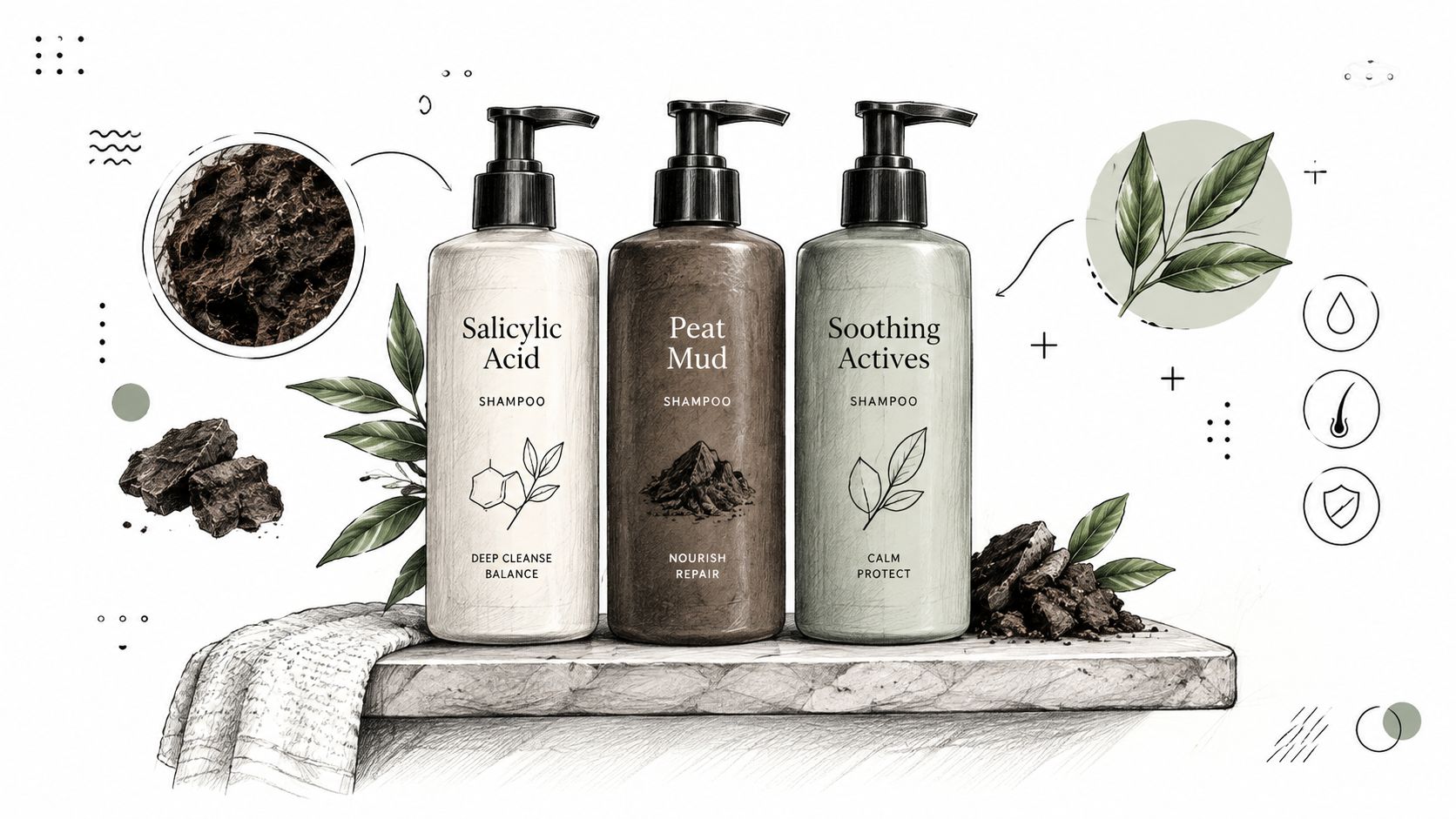
Matching partners to the scalp problem
- Piroctone olamine, ciclopirox olamine, or selenium sulfide may be relevant when dandruff involves recurring greasiness, itching, or seborrhoeic dermatitis features. The clinical trial involving ciclopirox olamine is an example of salicylic acid being used in a combination rather than as a standalone active.
- Humectants and conditioners help address the uncomfortable, dry feeling that can follow scale removal. Panthenol, jojoba oil, and other conditioning ingredients may support hair softness and manageability, although the exact effect depends on the complete formula.
- Peat mud can be included in a scalp system designed to combine cleansing with a more conditioning feel. It should be evaluated as part of the full ingredient list, not treated as a substitute for medically appropriate treatment.
- Leave-on pre-treatments may help target specific areas of stubborn scale before shampooing. They also require careful adherence to product directions because longer contact can increase irritation for some users.
The most balanced routine usually assigns each ingredient a clear job. Salicylic acid prepares the surface, cleansing removes loosened material, targeted actives address condition-specific concerns, and conditioning steps help the scalp and hair recover.
Building a Calmer Scalp Routine That Lasts
A lasting routine isn't the one that makes the scalp feel the most aggressively scrubbed. It's the one that removes visible buildup while preserving enough comfort that you can continue using it consistently.
Start by identifying the dominant pattern. If loose or attached flakes are the main concern, a salicylic acid shampoo may be a useful scale-focused step. If redness, greasiness, and persistent itching remain prominent, consider whether an antifungal or professional assessment belongs in the plan. If thick plaques, pain, bleeding, or marked sensitivity appear, don't keep escalating exfoliation without medical guidance.
Track practical changes rather than chasing a perfectly clear scalp after one wash:
- Visible scale: Are flakes less attached and easier to rinse away?
- Comfort: Is the urge to scratch decreasing?
- Barrier response: Does the scalp feel calm after washing, without escalating tightness or burning?
- Routine tolerance: Can you maintain the recommended schedule without needing harsher scrubbing?
A gentle shampoo between active washes, conditioner on the hair lengths, and careful rinsing can make a salicylic acid routine easier to sustain. You can find additional practical guidance in this scalp care routine, especially when your concern includes both scalp comfort and hair condition.
If symptoms remain persistent or confusing, a dermatologist can distinguish dandruff, seborrhoeic dermatitis, psoriasis, and other scalp conditions. The right diagnosis prevents you from treating inflammation as if it were only surface scale.
Explore Sphagnum Botanicals for peat-based scalp care, salicylic-acid formulas, conditioners, and routines designed to pair flake loosening with hydration and comfort. Choose the product or routine that matches your scalp pattern, follow its directions carefully, and adjust with professional guidance when symptoms persist.