

You've probably already bought the “gentle” moisturizer that stings beside your nose, the rich cream that leaves a greasy yellow sheen across your T-zone, or the lightweight gel that feels pleasant for an hour before your flakes return. Facial seborrheic dermatitis creates an irritating contradiction: skin can feel tight and flaky while also looking oily and congested.
The best moisturizer for seborrheic dermatitis on the face isn't automatically the richest, most natural, or most expensive formula. It's the one that supports a damaged barrier, avoids unnecessary irritation, stays comfortable in your climate, and works alongside antifungal or anti-inflammatory treatment instead of getting in its way. The practical test is simple: your face should feel calmer, not coated.
Table of Contents
- When Facial Seborrheic Dermatitis Makes Moisturizer Choices Feel Impossible
- What Facial Seborrheic Dermatitis Actually Does to Your Skin Barrier
- How to Choose the Right Moisturizer Texture for Your Face
- Key Ingredients That Make a Moisturizer Work on Seborrheic Dermatitis
- Ingredients and Moisturizer Types to Avoid on a Seb Derm Face
- How to Pair Your Moisturizer With Medicated Seb Derm Treatments
- Matching the Right Moisturizer Strategy to Your Skin and Climate
When Facial Seborrheic Dermatitis Makes Moisturizer Choices Feel Impossible
A person with facial seborrheic dermatitis often discovers the problem through trial and error. One moisturizer burns around the nasolabial folds immediately. Another applies smoothly but pills under sunscreen and makeup. A third feels comforting at night, then leaves the forehead shiny and the sides of the nose more scaly by morning.
That confusion makes sense because facial seborrheic dermatitis isn't ordinary dryness. It's a chronic inflammatory condition associated with barrier disruption, oil-rich facial areas, and sensitivity to Malassezia-related byproducts. A moisturizer can relieve tightness while still being a poor match for a flare if its texture traps heat, contains irritating fragrance, or relies on a lipid blend your skin doesn't tolerate.
The condition is common. It affects up to 10% of adults, and a large 2024 meta-analysis pooling 1,260,163 people from 121 studies estimated global prevalence at 4.38%, with adults at 5.64%. Those estimates and the chronic, recurring nature of the condition make moisturizer selection a maintenance decision, not a one-time purchase. (NIH-indexed review and meta-analysis)
The three filters that matter
I'd judge every candidate through three filters:
- Texture: Gel-creams and fluid lotions usually suit active, warm, or humid flares. Breathable lipocreams make more sense when the barrier feels tight or the weather is dry.
- Formula: Look for barrier-supportive ingredients such as ceramides, niacinamide, humectants, cholesterol, and carefully selected fatty acids. Don't assume every oil or “botanical” ingredient is helpful.
- Layering: A moisturizer should sit after the medicated treatment when practical, with enough time for the treatment to absorb. It shouldn't dilute the active or turn a light antifungal into a heavy occlusive layer.
Practical rule: If the moisturizer leaves a visible film across your T-zone by midday, it's probably the wrong texture for your facial seborrheic dermatitis, regardless of how impressive the ingredient list looks.
This guide doesn't rank a dozen nearly identical creams. It gives you decision rules for choosing between a plain barrier moisturizer and a treatment-adjacent formula, then shows how to pair that choice with medicated care. You'll end with a short, defensible shortlist rather than another listicle.
What Facial Seborrheic Dermatitis Actually Does to Your Skin Barrier
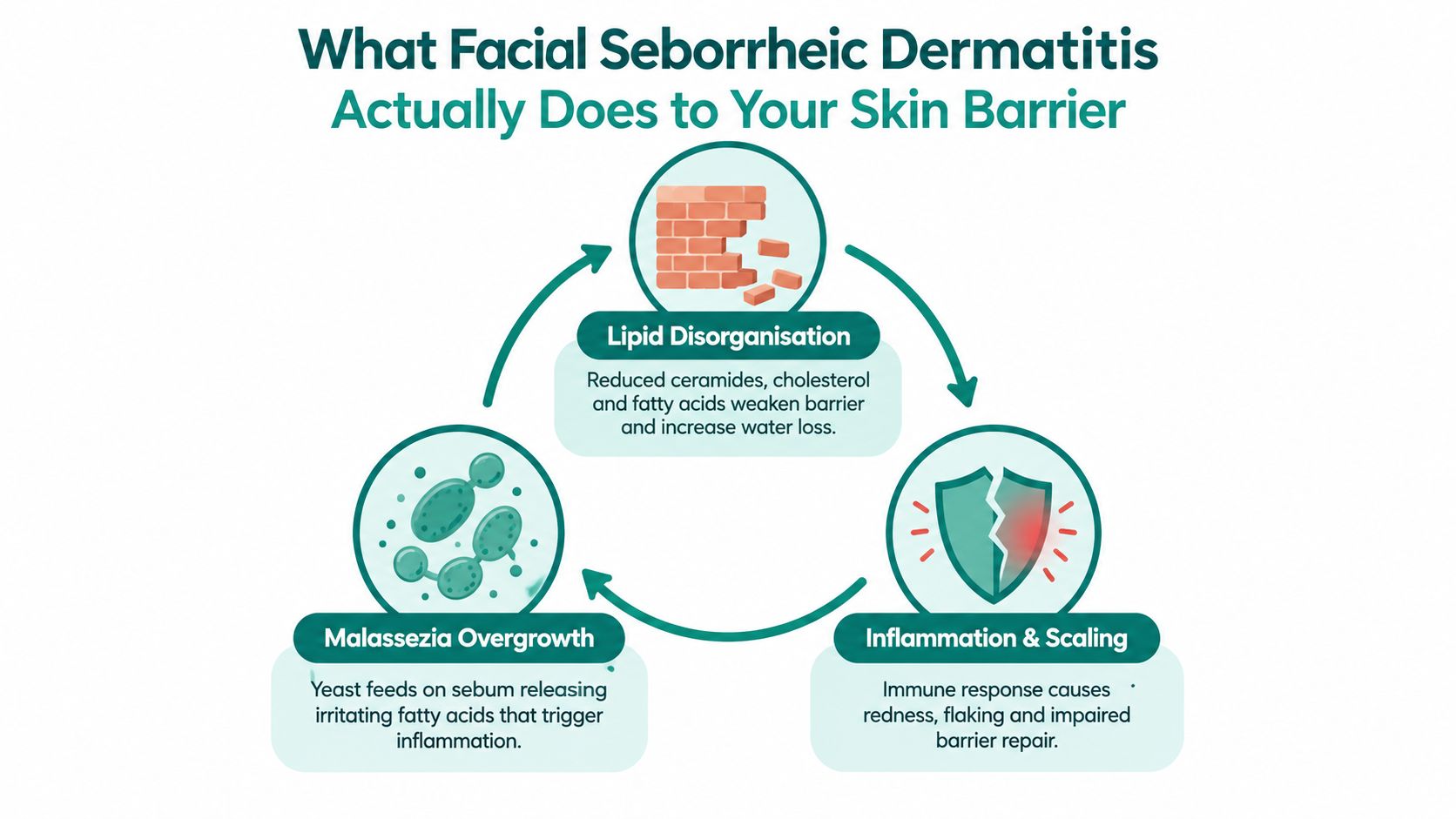
Facial seborrheic dermatitis combines three problems that a moisturizer alone can't fully solve: barrier weakness, Malassezia-related irritation, and inflammation. Treating only the first problem may make the face feel softer without controlling the recurring scale.
The outer skin barrier relies on an organized mixture of ceramides, cholesterol, and free fatty acids. When that lipid structure becomes disorganized or depleted, the stratum corneum loses efficiency. Water escapes more easily, irritants penetrate more readily, and products that were previously comfortable can start to sting.
Malassezia adds a second complication. This yeast naturally lives on skin and uses sebum components as a food source. Its enzymatic activity can produce free fatty acids that irritate susceptible skin. That's why a very rich oil-based product can feel soothing at first and still prove unhelpful on an oily, flaky T-zone.
The third problem is the immune response. The skin reacts to microbial byproducts and barrier disruption with redness, scaling, itching, or burning. A moisturizer can reduce friction and support recovery, but it isn't a substitute for an antifungal or anti-inflammatory treatment when active disease is driving the flare. Clinical guidance identifies topical antifungals, corticosteroids, and calcineurin inhibitors as key facial treatments, while nonirritating hydrating vehicles can make treatment more tolerable. (American Academy of Family Physicians review)
What the moisturizer should actually do
The moisturizer has three jobs:
- Replace or support barrier lipids without creating a heavy, greasy environment.
- Reduce water loss and friction so the face becomes less reactive.
- Improve treatment tolerance so you can use the prescribed or over-the-counter active consistently.
That's the reasoning behind a lightweight ceramide-forward formula. Ceramides are promising for barrier repair, but direct clinical trials proving their effectiveness specifically for seborrheic dermatitis remain limited. The stronger evidence comes from barrier-repair research in other inflammatory dermatoses, so I'd treat ceramides as a sensible specification, not a cure. (2025 review on ceramides and skin health)
A resource on how to soothe irritated skin with ArtNaturals can help you understand barrier-support concepts, but don't confuse a soothing serum with disease control. Similarly, the atopic and seborrheic dermatitis guide is useful background when you're comparing barrier symptoms across inflammatory conditions.
If you're considering a cleansing or renewal treatment rather than a daily moisturizer, the Nordic Peat Mask, 100% Pure Balneological Peat Mud – Professional Grade is described as 100% pure balneological peat mud for use on the face, scalp, and body. It shouldn't replace a leave-on moisturizer or medicated facial treatment, and an active flare is a poor time to experiment with any cleansing mask.
How to Choose the Right Moisturizer Texture for Your Face
Texture should follow the condition of your skin, not the marketing category printed on the bottle. “Nourishing” often means too much surface residue for a shiny, inflamed T-zone. “Water cream” can mean too little barrier support when cold air has left the cheeks tight and cracked.
Start with flare state. During active redness, burning, or greasy scale, choose a gel-cream or lightweight lotion with humectants and a low-residue finish. These textures spread over medicated areas without adding much warmth or occlusion. They're also easier to use across the full face when the nose folds are inflamed but the cheeks feel relatively normal.
Use the finish as your diagnostic tool
Apply a small amount to clean skin and watch what happens. A good formula should spread without dragging, settle without obvious shine, and remain comfortable when you move your face. “Sinks in within two minutes” is a useful practical benchmark. “Sits on the surface and remains tacky” suggests that the product may be too rich, too occlusive, or incompatible with your sunscreen and makeup.
Move to a breathable lipocream during maintenance or in a cold, dry climate. This texture can provide more ceramides and cholesterol than a watery gel while still avoiding the dense coating of a balm. Very dry, non-flared skin may tolerate a thin final layer of petrolatum, but I wouldn't make a heavy occlusive the default facial moisturizer for seborrheic dermatitis.
| Flare state | Climate | Recommended texture | Finish cue |
|---|---|---|---|
| Active redness, scale, or burning | Warm or humid | Gel-cream or fluid lotion | Settles quickly with little surface film |
| Active flare with tightness | Cold or dry | Lightweight barrier lotion | Comfortable, not greasy around the nose |
| Controlled symptoms | Mild or mixed | Breathable lipocream | Soft finish without midday shine |
| Very dry skin without active scale | Cold and dry | Lipocream, with a thin occlusive layer only if needed | Protected but not glossy across oily zones |
| Oily T-zone with dry cheeks | Any climate | Light lotion on the center of the face, slightly richer cream on cheeks | No uniform heavy layer over the whole face |
Climate changes the answer. Dry winter air can justify moving up one texture level, while humid weather usually rewards a thinner formula and less frequent layering. Don't moisturize the entire face as if every zone has the same needs.
Key Ingredients That Make a Moisturizer Work on Seborrheic Dermatitis
A good formula doesn't need a long ingredient list. It needs the right division of labor. Humectants bind water, barrier lipids support the outer skin structure, and calming ingredients reduce the chance that routine use becomes irritating.
Ceramides are the structural centerpiece. Ceramide NP is a useful label signal, especially when it appears with cholesterol and fatty acids rather than alone. The broader barrier literature supports ceramide-containing moisturizers, but direct effectiveness trials in seborrheic dermatitis are still lacking. That means I'd choose ceramides because the mechanism is sound and the indirect evidence is useful, not because the word “ceramide” guarantees a flare-free result. (Evidence review on ceramide moisturizers)
Ingredient comparison
| Ingredient | Primary function | Evidence | Typical concentration |
|---|---|---|---|
| Ceramides, especially ceramide NP | Replenish barrier-supportive lipids | Indirect support from inflammatory dermatitis and barrier-repair research. Direct SD trial evidence remains limited | Label-dependent |
| Cholesterol | Works with ceramides and fatty acids in barrier organization | Supported as part of physiologic barrier-lipid systems | Label-dependent |
| Linoleic acid | Provides a skin-compatible fatty acid component | Mechanistically relevant to epidermal lipid integrity | Label-dependent |
| Niacinamide | Supports barrier function and helps reduce water loss | Comparative moisturizer data support improved barrier performance in dry, inflamed skin | Product-dependent |
| Panthenol | Humectant and skin-conditioning support | Useful for irritated skin, but not an antifungal treatment | Product-dependent |
| Hyaluronic acid | Water binding and surface hydration | Helpful for hydration, but needs a barrier layer over it | Product-dependent |
| Glycerin | Reliable humectant support | Practical, well-tolerated hydration option in many formulas | Product-dependent |
Niacinamide deserves special attention. Comparative randomized evidence summarized in a major review found niacinamide moisturizers reduced transepidermal water loss more effectively than white petrolatum in atopic dry skin and improved barrier function more quickly and sustainably than conventional moisturizers. That doesn't prove niacinamide treats seborrheic dermatitis, but it makes a lightweight niacinamide-and-ceramide formula a rational choice when the face is dry, reactive, and prone to flaking. (Review of niacinamide in skin care)
What I'd look for on the label
- Ceramides plus cholesterol and fatty acids: This is more convincing than a token ceramide added to an otherwise fragranced cream.
- Niacinamide: Useful when the formula remains comfortable and doesn't cause flushing or stinging.
- Panthenol, glycerin, or hyaluronic acid: Choose one or more for water-binding support, then seal with a light barrier cream.
- Calming extras: Pseudo-ceramides, bisabolol, allantoin, and oat avenanthramides can be worth considering if your skin tolerates them.
- Low-irritation vehicle: Fragrance-free is the baseline. A technically impressive active blend is irrelevant if the base burns.
Layering is straightforward. Apply a humectant-rich product to slightly damp skin, then place the lipid-supporting moisturizer over it. In humid weather, glycerin often feels more predictable than a heavily layered hyaluronic acid routine. If you're choosing products for a polished finish, this guide to choose products for a glam look is best treated as makeup-planning advice, not seborrheic dermatitis treatment guidance.
Ingredients and Moisturizer Types to Avoid on a Seb Derm Face
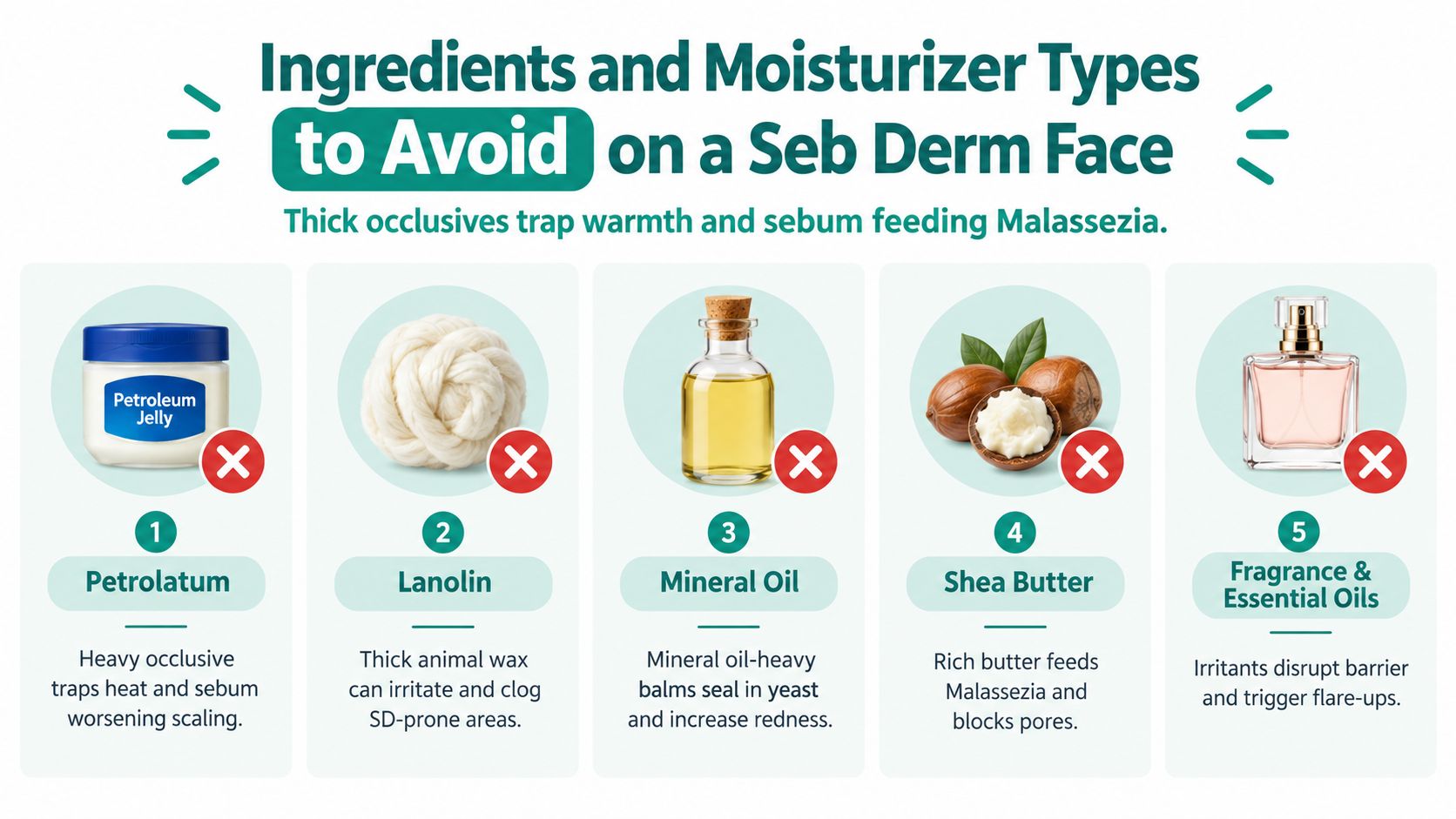
The common assumption that facial seborrheic dermatitis always needs the richest possible cream is wrong. Heavy occlusion can temporarily soften scale while leaving the oily central face warmer, shinier, and harder to manage. Petrolatum isn't automatically forbidden, but a thick petrolatum-heavy balm across an active T-zone is rarely my first choice.
Lanolin, mineral-oil-heavy balms, and rich butters can also feel excessive when the face is already oily. Some people tolerate them, but tolerance is personal and the formulation matters. Don't interpret “natural” as “Malassezia-safe.” Coconut oil, olive oil, and certain fatty esters are poor default choices when you're trying to reduce variables during a flare.
The label-reading red flags
- Fragrance and essential oils: These add avoidable irritation when the barrier is already compromised.
- Heavy butter and oil blends: Shea butter and rich plant oils may leave an uncomfortable film on oily facial zones.
- Long-chain esters: Ingredients such as isopropyl palmitate and myristyl myristate deserve caution in acne-prone or Malassezia-sensitive routines.
- Strong exfoliating formulas: Glycolic acid and other aggressive acids can intensify burning during an active flare.
- High urea levels: Urea can be useful in the right setting, but higher-strength formulas may sting compromised facial skin.
- Overloaded “clarifying” products: Several exfoliants, essential oils, and drying agents in one bottle create a poor recovery routine.
Better substitutes for common problem textures
If you need some occlusion on dry, non-flared areas, a dimethicone-based cream can provide a smoother silicone barrier without the same greasy feel as a dense oil balm. Squalane is often a more practical lipid option than heavier plant oils, though your own skin response still decides the matter. In humid conditions, glycerin-led hydration often feels cleaner than repeatedly adding hyaluronic acid layers.
Don't use “non-comedogenic” as your only filter. That label doesn't answer whether a product contains fragrance, irritating essential oils, a heavy lipid system, or a texture that makes your seborrheic dermatitis worse. Check the full INCI list, patch test near the jawline, and change one product at a time. A broader guide to products to avoid with dry skin can help with general label screening, but facial seborrheic dermatitis requires extra attention to oil load and irritation.
How to Pair Your Moisturizer With Medicated Seb Derm Treatments
Moisturizer supports treatment. It doesn't replace the antifungal or anti-inflammatory step that controls active seborrheic dermatitis. Clinical guidance places topical antifungals, corticosteroids, and calcineurin inhibitors among the main facial treatment options, while a nonirritating vehicle improves comfort and adherence. (Clinical treatment review)
A practical morning sequence
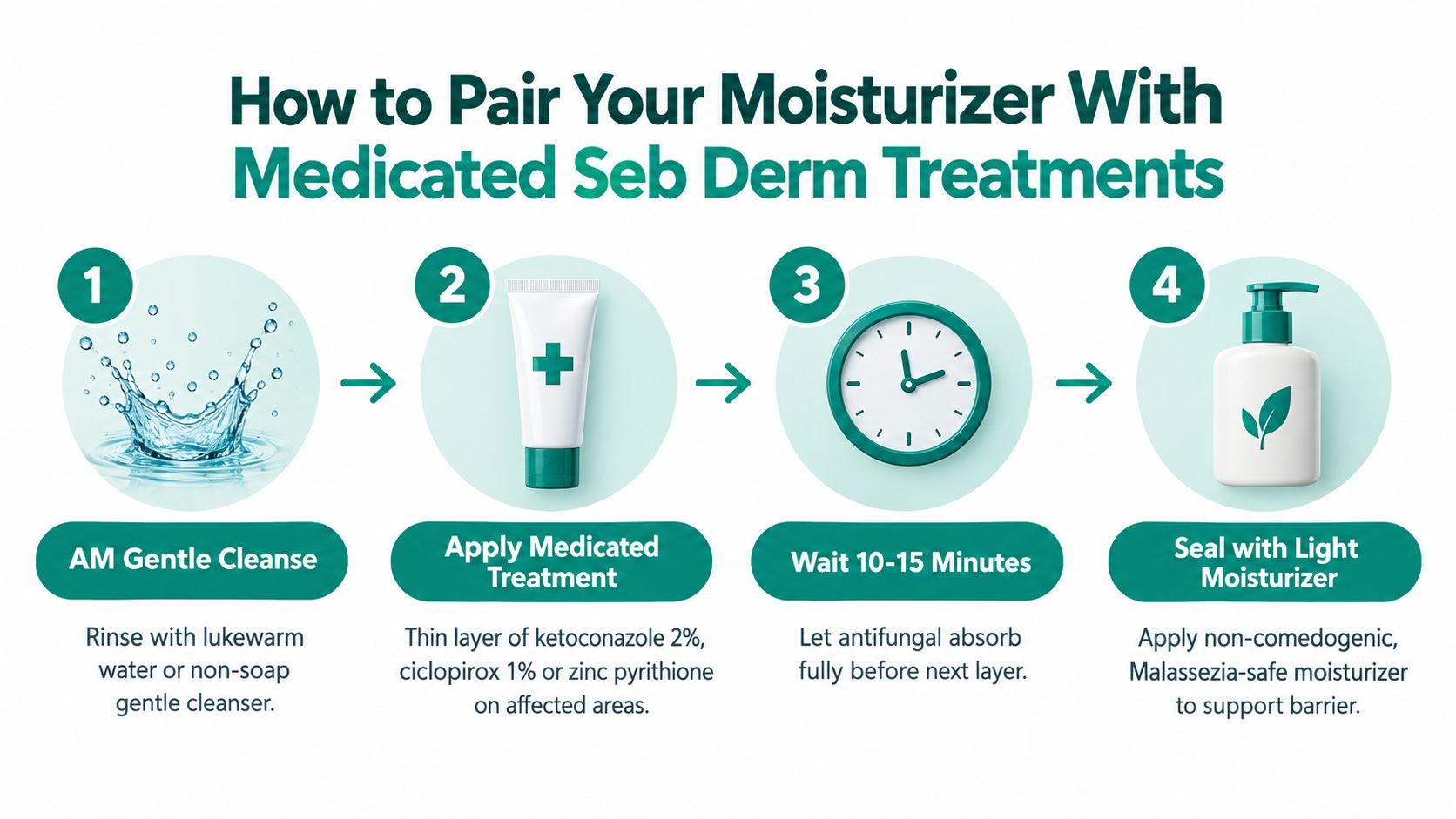
- Cleanse gently. Rinse with lukewarm water or use a non-soap, fragrance-free cleanser. Don't scrub scale away.
- Apply the medicated product. Use the antifungal or prescribed anti-inflammatory only where directed. Keep products away from the eyelids unless your clinician has specifically approved them there.
- Allow absorption. Give the treatment time to settle before adding moisturizer. A short waiting period helps prevent unnecessary dilution.
- Moisturize. Apply a thin layer across the face or the barrier-impaired areas, depending on how your skin behaves.
- Finish with sunscreen. Use a comfortable broad-spectrum sunscreen that doesn't sting. Mineral filters such as zinc oxide or titanium dioxide may be easier to tolerate when the skin is sensitized.
For a topical steroid, apply a thin amount to the red patches as directed, then use moisturizer over the broader face. Don't extend facial steroid use indefinitely without medical supervision. Calcineurin inhibitors may be used differently, so follow the prescription instructions rather than applying a universal layering rule.
A light moisturizer can usually go over a medicated product once it has absorbed. Avoid turning the routine into an occlusive sandwich unless your prescriber specifically wants that approach. More occlusion can increase penetration, which may be useful for a short course but is not a sensible default for long-term facial use.
Adjust the routine to the day
- Cold winter air: Use a lipocream instead of a watery gel, and add a small amount to tight cheek areas rather than coating the oily folds.
- Hot, humid weather: Reduce layers, use a lighter lotion, and rinse away sweat gently after exercise.
- After exercise: Cleanse or rinse promptly, pat dry, and reapply a thin moisturizer if the face feels tight.
- Makeup days: Let the moisturizer settle before sunscreen and makeup. Pilling usually signals too many layers, incompatible textures, or applying too much product.
For scalp involvement, don't transfer a facial moisturizer routine to shampoo treatment. A separate resource on medicated shampoos for seborrheic dermatitis is more relevant to scalp care.
Matching the Right Moisturizer Strategy to Your Skin and Climate
The right moisturizer tier depends on three things: how active the disease is, how damaged the barrier feels, and how much treatment your skin already needs. Don't upgrade to a more complicated cream because your face feels dry. First ask whether the antifungal plan is controlling the inflammation.
Three useful tiers
Tier one, plain barrier moisturizer. Choose this when symptoms are mild or controlled, the main complaint is tightness or flaking, and a simple antifungal routine is doing its job. A fragrance-free ceramide lotion or breathable lipocream is the default.
Tier two, treatment-adjacent moisturizer. Consider this when a plain moisturizer improves comfort but doesn't adequately address recurring redness, itch, or scale. Evidence exists for specialized creams combining antifungal, antimicrobial, anti-inflammatory, and antiseborrheic properties. One randomized controlled study reported better outcomes than a basic moisturizer in moderate facial disease, including a successful investigator global assessment rate of 44% versus 16% at week eight. (Randomized controlled study)
That doesn't mean every “anti-redness” cream works. It means a product with treatment-adjacent activity may be more logical than repeatedly increasing moisturizer richness when inflammation remains active.
Tier three, dermatology review. Escalate when the diagnosis is uncertain, symptoms persist despite consistent treatment, or the pattern looks atypical. Periorificial redness, scaling close to the eyes, thick plaques, painful cracking, oozing, or widespread involvement deserves professional assessment. Rosacea, psoriasis, contact dermatitis, and other conditions can resemble seborrheic dermatitis.
| Skin and climate profile | Recommended tier | Key product cues | When to escalate |
|---|---|---|---|
| Oily T-zone, mild scale, humid climate | Tier one | Fluid lotion, gel-cream, glycerin, ceramides | Persistent redness despite appropriate treatment |
| Dry cheeks, active nasal-fold flare, cold climate | Tier one with richer zones | Breathable lipocream, ceramides, cholesterol, low fragrance | Burning, cracking, or spreading scale |
| Recurrent redness and scale despite a plain moisturizer | Tier two | Treatment-adjacent formula with clearly identified active functions | Symptoms remain uncontrolled or worsen |
| Eye-area scaling or uncertain diagnosis | Tier three | Keep routine bland and seek professional guidance | Prompt evaluation is appropriate |
| Thick plaques, severe irritation, or sudden extensive disease | Tier three | Don't keep experimenting with cosmetic products | Dermatology assessment |
For adults, facial seborrheic dermatitis commonly follows a recurrent course, so the moisturizer should be sustainable enough for long-term use. Don't judge it only by how hydrated your skin looks after one application. Judge whether it reduces tightness and flaking without increasing shine, stinging, or treatment conflicts.
The best moisturizer for seborrheic dermatitis on the face is usually a fragrance-free, lightweight barrier formula with ceramides, compatible humectants, and a restrained lipid load. Use a treatment-adjacent product when inflammation remains active, and see a dermatologist when the pattern exceeds what skincare can responsibly manage.
If you're building a broader routine for flaky or irritated skin, visit Sphagnum Botanicals to explore its Nordic peat-based scalp, hair, and skin care range. Keep facial moisturizer selection focused on barrier support, and use any peat or scalp-focused product only according to its intended area and directions.