

You washed your hair, treated your scalp, and expected relief. Then the flakes showed up again by midweek, this time brighter against dark roots, darker clothes, and a style you weren't planning to disturb for several more days.
That's the part most dandruff advice misses. For Black hair, the question isn't only which medicated shampoo works. The question is which one clears the scalp without drying the hair shaft, roughing up the cuticle, or forcing you into a wash schedule your texture can't tolerate.
I see this tension constantly with tightly coiled, curly, relaxed, color-treated, and protective-styled hair. A formula can be effective on paper and still be a poor fit in practice if it leaves the hair brittle, dull, tangled, or harder to maintain. Good scalp care for textured hair has to do two jobs at once. It has to reduce flakes and itch, and it has to protect hair integrity.
Why Black Hair Makes Dandruff Harder to Treat
A common pattern goes like this. Someone buys a strong anti-dandruff shampoo, uses it the way the label suggests, and the scalp feels cleaner for a day or two. Then the hair starts feeling stripped. The ends get rough. The style loses definition. So they wait longer between washes, use more oils to compensate, and the scalp issue comes right back.
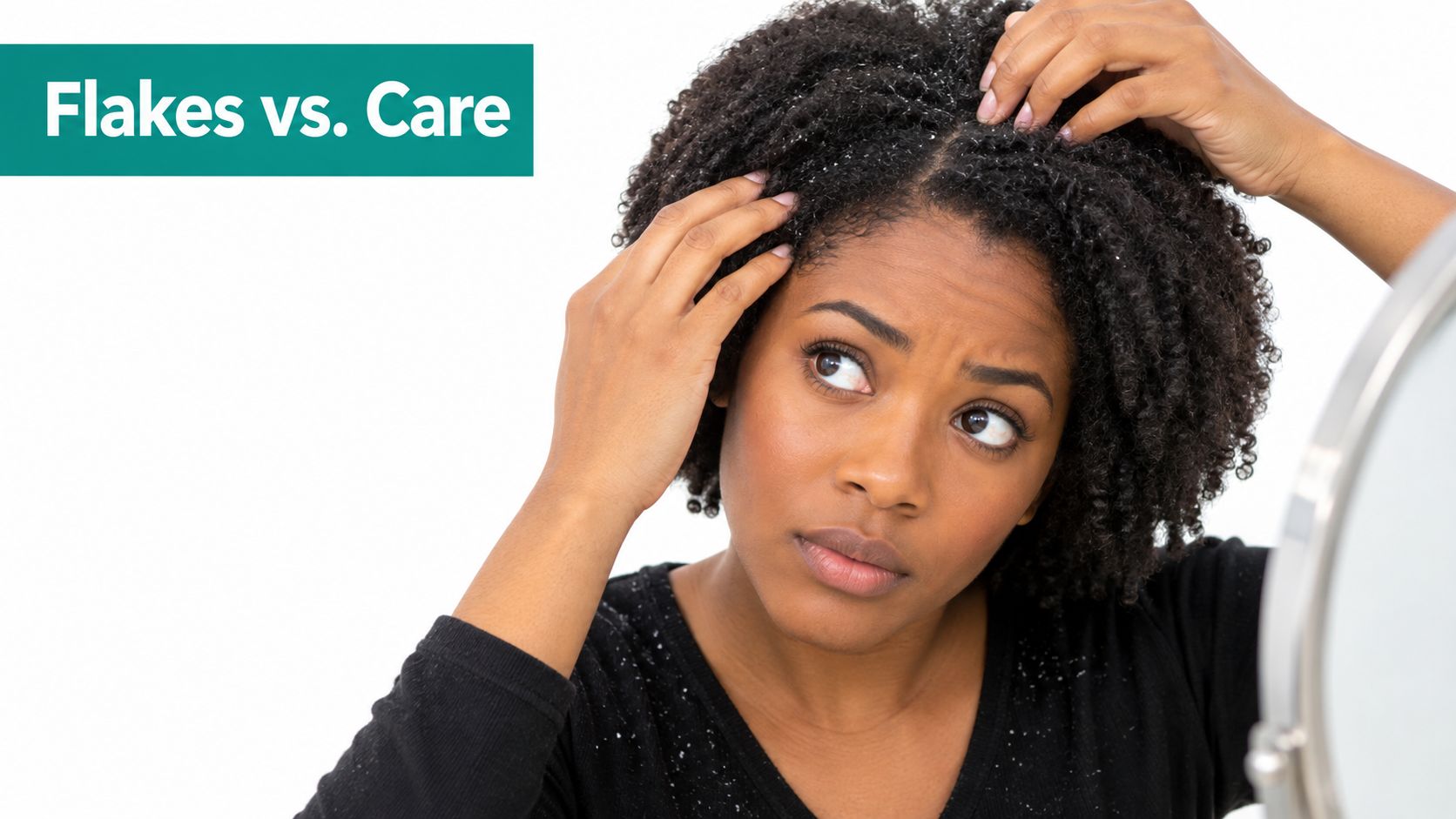
That cycle happens because dandruff shampoo for Black hair has to work within different hair behavior. Tightly coiled strands don't usually tolerate frequent cleansing the same way straighter hair does. The scalp may need treatment, but the lengths often need protection from that treatment.
Why the strongest shampoo isn't always the right one
With textured hair, the biggest mistake is treating the entire head like the scalp and the hair need the same thing. They don't.
- The scalp needs contact with the active ingredient. That's where flaking, itch, and scale are happening.
- The hair lengths need less exposure. Repeated contact with medicated cleansers can leave coiled hair dry and harder to detangle.
- The wash schedule matters as much as the ingredient. A good formula used too often can still create a bad outcome.
Practical rule: If a dandruff shampoo clears flakes but leaves your hair fragile, your routine isn't working yet.
That's why texture-aware routines matter more than generic advice. If you're trying to figure out whether a formula approach suits curls and coils, it helps to read product guidance that addresses texture, such as this piece on whether a shampoo is suitable for curly hair.
The Scalp and Hair Data Behind the Problem
For many Black clients, dandruff doesn't feel like a minor cosmetic nuisance. It feels persistent, visible, and hard to control without sacrificing the hair itself. The population data supports that experience.
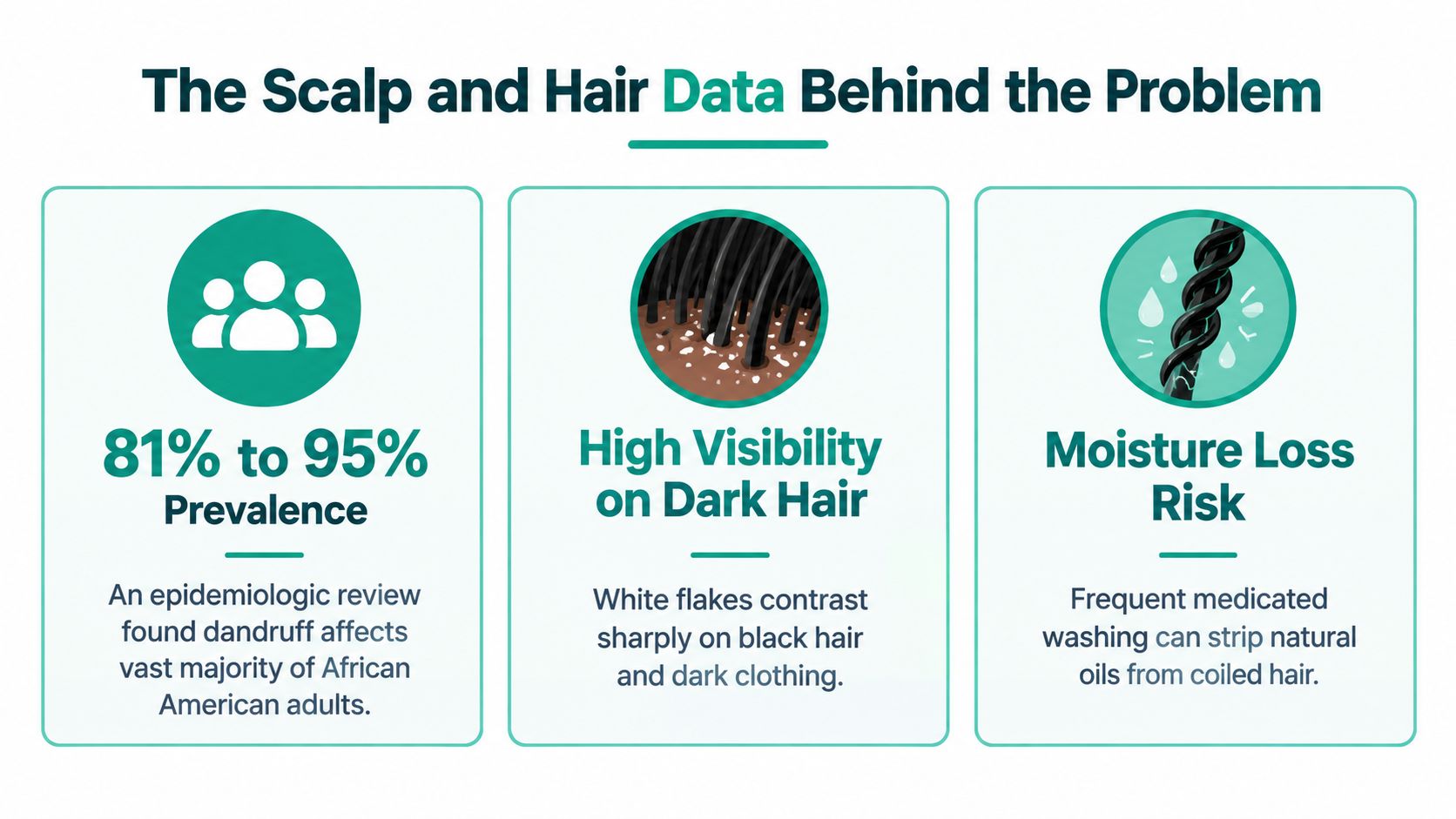
A review of epidemiologic studies estimated dandruff prevalence at 81% to 95% among African Americans, compared with 66% to 82% among Caucasians and 30% to 42% among Chinese populations, according to this review of scalp and hair disorders data. The same review also summarized one study reporting 25.3% for scalp pruritus, 11.7% for dysesthesia, and 40.2% for hair loss, with Black patients showing higher rates than White patients for all three measures.
What those numbers mean in real life
Higher scalp symptom burden changes how I think about dandruff shampoo black hair routines. It means the person in front of me often isn't dealing with flakes alone. They may also be dealing with itch, tenderness, breakage concerns, shedding anxiety, or wash-day avoidance because every medicated wash seems to set the hair back.
That's why “just wash more often” usually fails on textured hair. It can improve scalp access while making the fiber feel worse.
Visibility is part of the burden
White scale is more noticeable on dark hair and dark clothing. Even mild flaking can look severe. That visual contrast changes what people mean when they say a shampoo “isn't working.” Sometimes the scalp is somewhat improved, but the residue, dryness, or persistent visible scale still makes the result unacceptable.
If you're trying to separate dandruff from plain dehydration, this guide on balancing dry scalp naturally is a useful companion read because dryness and dandruff can overlap, but they don't behave the same way.
Data matters here because it validates the experience many Black clients already know firsthand. This isn't vanity. It's a common scalp burden with hair-specific treatment constraints.
Anti-Dandruff Ingredients Compared for Textured Hair
Not all anti-dandruff actives ask the same things of textured hair. Some work fast but can feel harsher in practice. Others offer useful scalp control while fitting better into a lower-frequency wash routine.
| Active Ingredient | Efficacy Signal | Black Hair Consideration | Typical Frequency Guidance |
|---|---|---|---|
| Ketoconazole 2% | In a randomized, double-blind trial, it was statistically superior to selenium sulfide 2.5% at day 8 | Often a strong option when visible flaking needs quick control and you want to limit residue concerns on dark hair | Match use to scalp severity and hair tolerance rather than copying straight-hair routines |
| Selenium sulfide 2.5% | Outperformed placebo in the same trial | Can help dandruff, but in that trial selenium sulfide accounted for all nine adverse events reported during treatment | Better considered carefully if your scalp is reactive or your hair already feels dry |
| Zinc pyrithione | A potentiated zinc pyrithione shampoo showed superior anti-dandruff performance versus a zinc pyrithione plus climbazole formula, with deeper follicular delivery and greater antifungal potency | Useful when you need steady scalp control without chasing flakes through repeated rewashing | Often fits maintenance use, but textured hair still benefits from spacing washes |
| Selenium disulfide | A 2025 study found it reduced dandruff signs and itching across hair-type groups after 28 days | Shows that efficacy can still be preserved across hair textures when the routine is adjusted properly | Frequency should still reflect curl pattern and dryness risk |
| Salicylic acid | The FDA monograph framework includes salicylic acid among established anti-dandruff actives | Especially helpful when visible scale and buildup need loosening, but the lengths usually need follow-up conditioning | Best used with targeted scalp application, not as an all-over stripping wash |
What the ingredient comparison suggests
A randomized trial found that ketoconazole 2% shampoo was statistically superior to selenium sulfide 2.5% at day 8, and selenium sulfide accounted for all nine adverse events reported during treatment, as summarized in this clinical review of dandruff therapies. For clients with dark hair where flakes and residue are highly visible, tolerability matters almost as much as antifungal strength.
The same review also notes a four-week clinical study in which a potentiated zinc pyrithione formula outperformed a dual-active zinc pyrithione plus climbazole formula, with deeper delivery into the lower infundibulum and greater antifungal potency. That matters for tightly coiled hair because a formula that works more efficiently may reduce the urge to rewash too soon.
Frequency changes with texture
The American Academy of Dermatology guidance summarized in the same review says curly or tightly coiled hair may need dandruff shampoo once a week, versus two to three times weekly for straight or wavy hair. That's one of the most useful distinctions in this entire conversation, because ingredient choice and frequency can't be separated.
If flaking comes with heavy buildup, I also look closely at exfoliating options and how they're used on the scalp, not the lengths. This overview of shampoo with salicylic acid is helpful for understanding where keratolytic cleansing fits.
One practical example is the PsoriAid Moderate Routine, an enhanced scalp and body care routine built around PsoriAid+ Shampoo with 3% salicylic acid and Nordic peat mud for deeper cleansing and visible flake removal, paired with a conditioner and body wash. In textured-hair terms, that kind of setup makes sense when the scalp clearly needs exfoliating help but the hair lengths still need softness restored after active cleansing.
A textured-hair routine improves when you stop asking, “What's the strongest active?” and start asking, “Which active can my scalp benefit from at a frequency my hair can survive?”
Product Options Centered on Scalp Balance and Hair Integrity
A texture-aware product strategy starts with the scalp problem in front of you. Thick scale, fine flaking, itch, irritation, and fragile lengths don't all need the same formula profile.
When visible flakes and buildup are the main issue
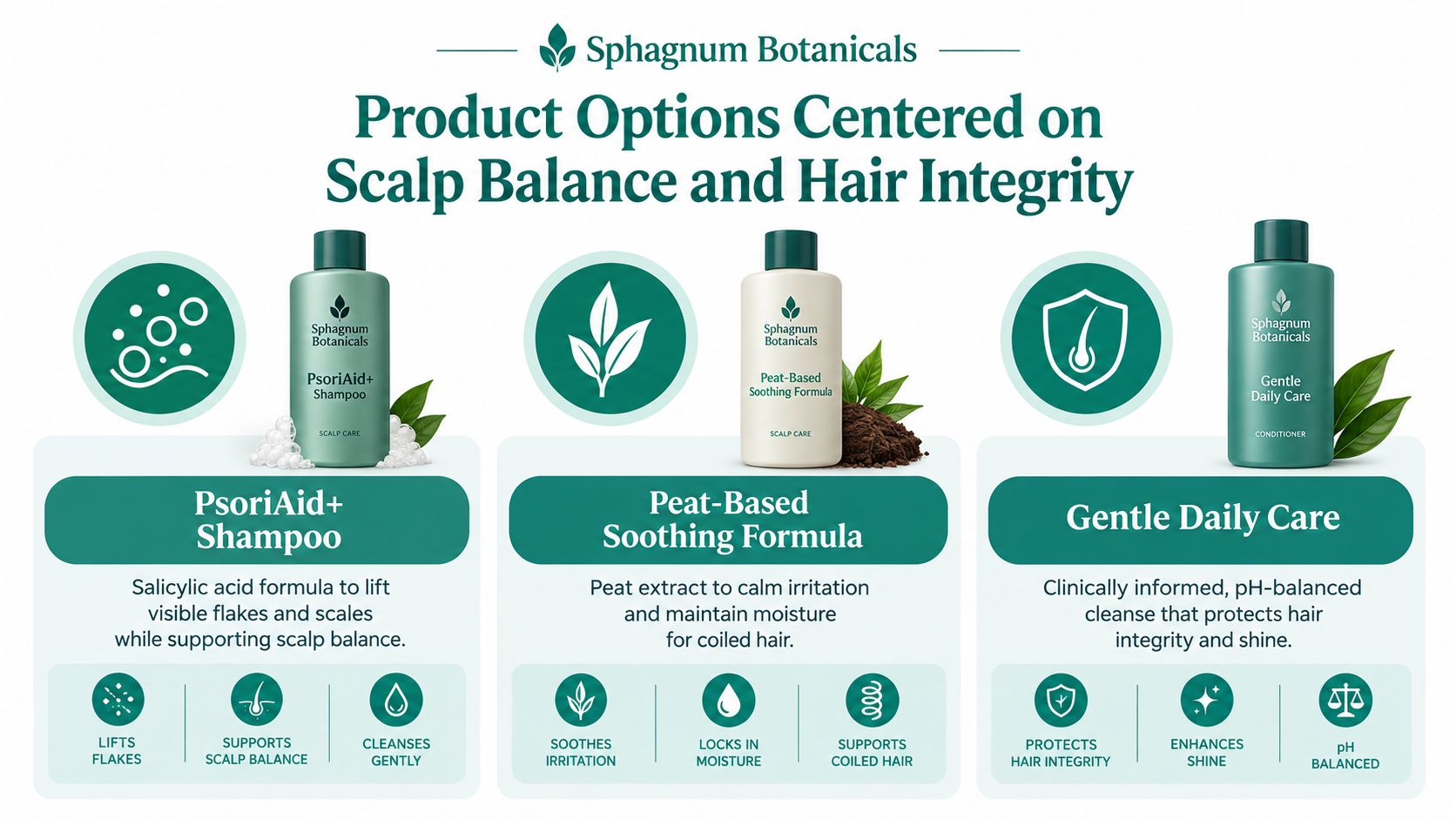
A salicylic acid shampoo usually makes the most sense when scale is sitting on the scalp and clinging near the root. In that situation, you need help loosening buildup, not just calming itch. A peat-based formula with salicylic acid can make that process less blunt than old-school harsh cleansing, especially if you keep the contact mainly at the scalp and follow with a conditioner on the lengths.
The FDA's monograph history matters here too. The modern over-the-counter framework for dandruff, seborrheic dermatitis, and psoriasis products was established when the FDA issued its final OTC monograph in 1991, later codified and amended in 1994 and 2007, listing active ingredients such as coal tar, pyrithione zinc, salicylic acid, and selenium sulfide, as described in this AAD meeting summary on dandruff treatment history. That framework is one reason active scalp care today is based on defined ingredients and measurable concentrations rather than vague cosmetic claims.
When irritation and frequent cleansing tolerance matter more
Some people don't need a stronger exfoliating shampoo every time. They need a gentler formula that calms an itchy, flaky scalp without creating that squeaky, over-cleansed feel that textured hair often hates. In those cases, a milder anti-dandruff or soothing shampoo often fits better between stronger treatment washes.
A conditioner matters just as much here. Once the scalp has had active contact, the lengths should get slip, softness, and reduced friction back. That's what helps preserve detangling ease and style retention.
Looking at options without overcomplicating it
Here's the lens I use:
- Choose exfoliating support when you can see adhered flakes, scale, or obvious buildup.
- Choose gentler scalp care when the issue is more itch and irritation than thick scale.
- Choose added conditioning support when the hair is dry, fragile, relaxed, or color-treated.
- Choose follicle-focused support only when thinning is also part of the concern, not as a substitute for treating dandruff.
If you like comparing ingredient approaches before buying, this roundup can help you compare Derma E scalp treatments against the broader category. It's useful not for copying someone else's routine, but for learning how scalp-relief formulas differ in focus.
How to Apply Anti-Dandruff Shampoo on Tightly Coiled Hair
Application technique changes everything. I've seen the same shampoo fail in one routine and work well in another because the second person stopped washing the whole hair shaft with medicated lather.
The scalp-only method
Use this sequence:
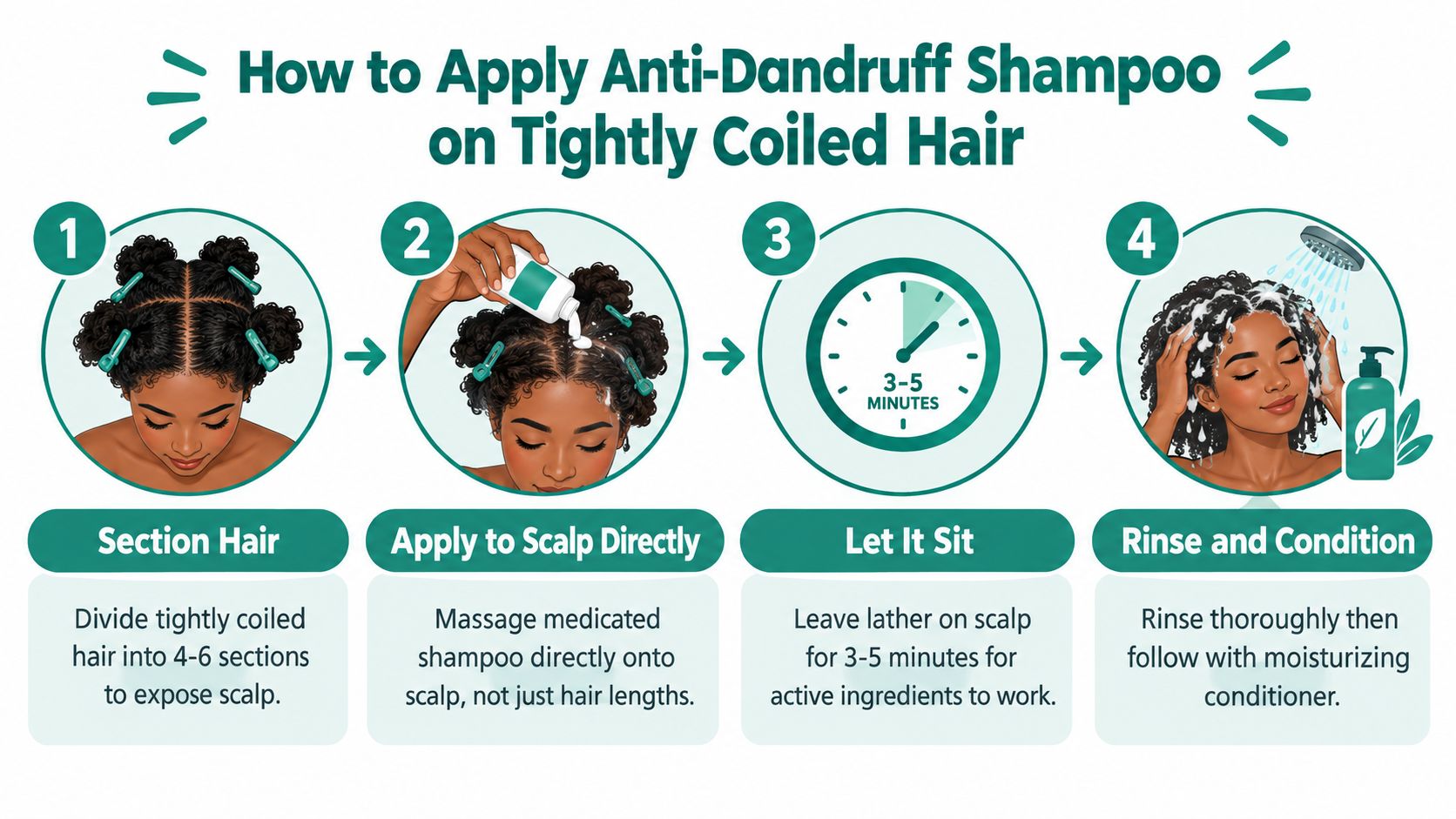
- Section the hair first. Work in clean parts so you can actually reach the scalp.
- Apply shampoo directly to the scalp. Don't rely on runoff to do the treatment work.
- Massage with fingertips, not nails. You want contact, not abrasion.
- Let it sit for the label time. Active ingredients need contact time.
- Rinse thoroughly. Residue is especially visible on dark strands.
- Condition only from mid-length to ends. The scalp problem is not a cue to coat the roots with heavy conditioner.
A helpful visual demonstration appears below.
Why this works better on coily hair
This method solves two problems at once. It improves scalp treatment accuracy, and it reduces unnecessary exposure of the hair shaft to active cleansers.
Apply the medicine where the problem lives. Protect the hair where the fragility lives.
If you've been lathering the full length from root to tip, that alone may be why your dandruff shampoo black hair routine feels harsher than it should.
Choosing the Right Product for Your Specific Concern
The right routine usually becomes obvious once you stop grouping every flaky scalp into one bucket. Start with the main complaint, not the trendiest ingredient.
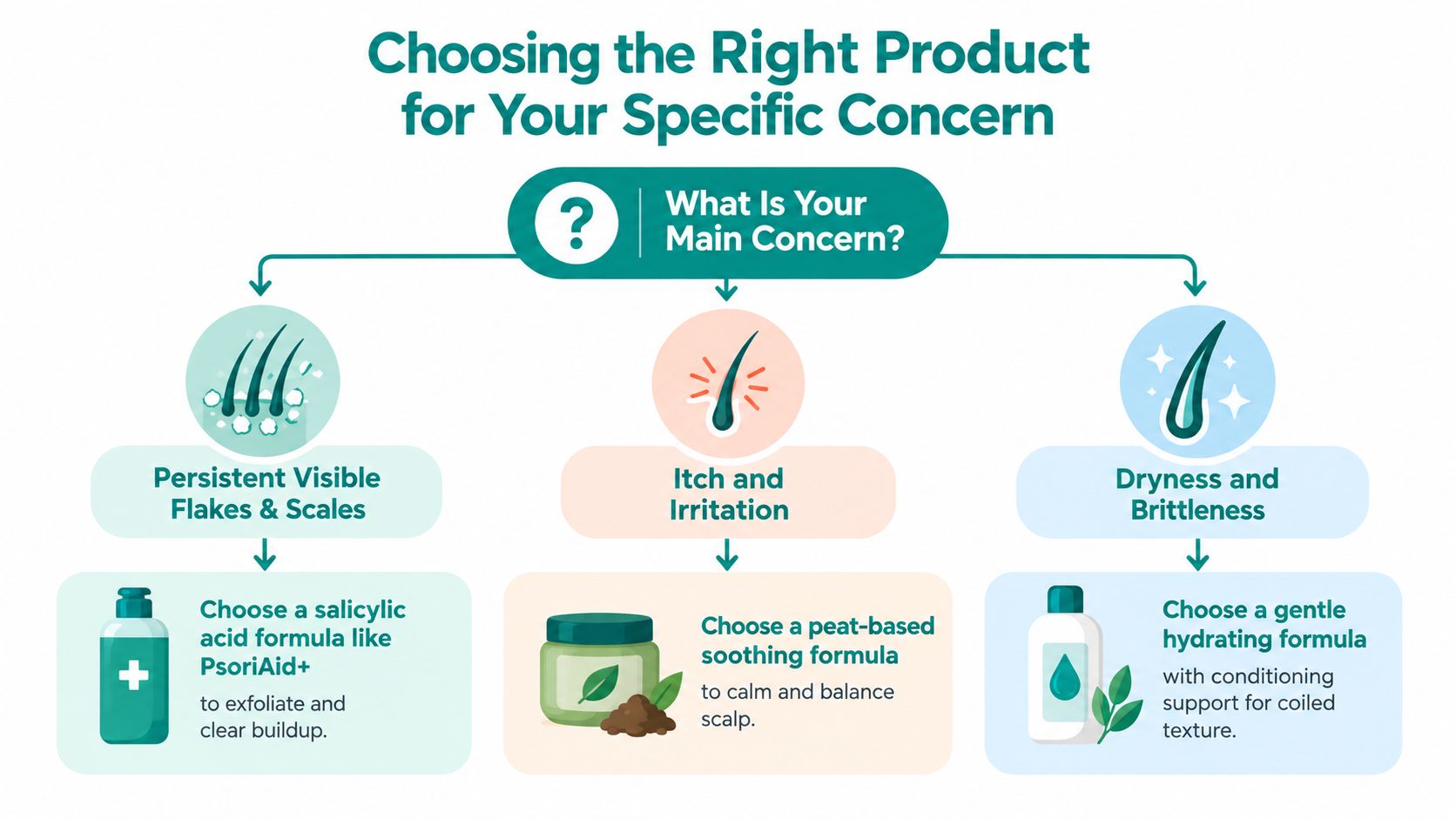
Match the product type to the problem
-
Persistent visible flakes and scalp scale
Go toward a salicylic acid-based wash. This is the lane for buildup, adherent scale, and roots that need help shedding what's already sitting there. -
Itch and irritation without heavy scale
A gentler soothing formula often makes more sense. You still want scalp-focused cleansing, but not the most aggressive approach. -
Dryness and brittleness during treatment
Keep the medicated step scalp-only and make sure the follow-up conditioner is doing real work on the lengths. The shampoo alone won't solve this. -
Thinning alongside dandruff symptoms
Don't abandon scalp treatment. Add supportive products for fragile hair, but keep the dandruff routine intact.
A simple decision rule
If your flakes are thick and visible, choose exfoliation. If your scalp is mainly itchy and reactive, choose gentleness. If the hair is what suffers every time you treat the scalp, your next improvement should come from application method and conditioning support, not from chasing a harsher shampoo.
Building a Weekly Routine That Actually Works
Tightly coiled hair usually responds better to rhythm than intensity. A predictable schedule beats panic-washing every time the flakes show up.
A workable weekly pattern
Because dermatology guidance notes that tightly coiled hair may need medicated shampoo only once a week, a realistic routine often looks like this:
-
Wash day
Use your medicated shampoo on sectioned scalp only. Let it sit. Rinse thoroughly. Condition mid-lengths and ends well. -
Midweek scalp check
Assess whether the scalp feels itchy, tight, or congested. If needed, use a light scalp-support step that doesn't force a full wash. -
Weekend repair focus
Give the lengths extra moisture and slip so the next treatment wash doesn't start from a dry baseline.
What usually fails
- Overcorrecting with frequent active washing damages the hair faster than it stabilizes the routine.
- Putting oils over untreated buildup can make the scalp feel coated without addressing flakes.
- Changing products too quickly makes it hard to tell whether the issue is the formula or the method.
For readers trying to make the whole week more coherent, this guide to a scalp care routine is useful because it puts shampooing into a broader maintenance pattern instead of treating wash day as the entire plan.
Frequently Asked Questions About Dandruff Shampoo for Black Hair
Can natural or peat-based products replace medicated dandruff shampoo
Sometimes they can support comfort, especially when the scalp feels irritated or dry. But when flakes are persistent, visible, or scale-like, I treat soothing care and clinically active dandruff treatment as different jobs.
How long does it take to see improvement
Most people need consistent use over a few weeks, not one wash, before the scalp settles. With tightly coiled hair, consistency matters more than trying to force faster results by washing too often.
Can I use dandruff shampoo on color-treated or chemically treated hair
Usually yes, but technique matters. Keep the shampoo focused on the scalp, rinse thoroughly, and put your conditioning effort on the lengths. That lowers unnecessary exposure of treated hair to active cleansers and helps preserve softness and manageability.
The best dandruff shampoo for Black hair is the one that treats the scalp and respects the hair's limits. If you get that balance right, flakes become more manageable, wash day becomes less punishing, and your routine finally starts working with your texture instead of against it.