

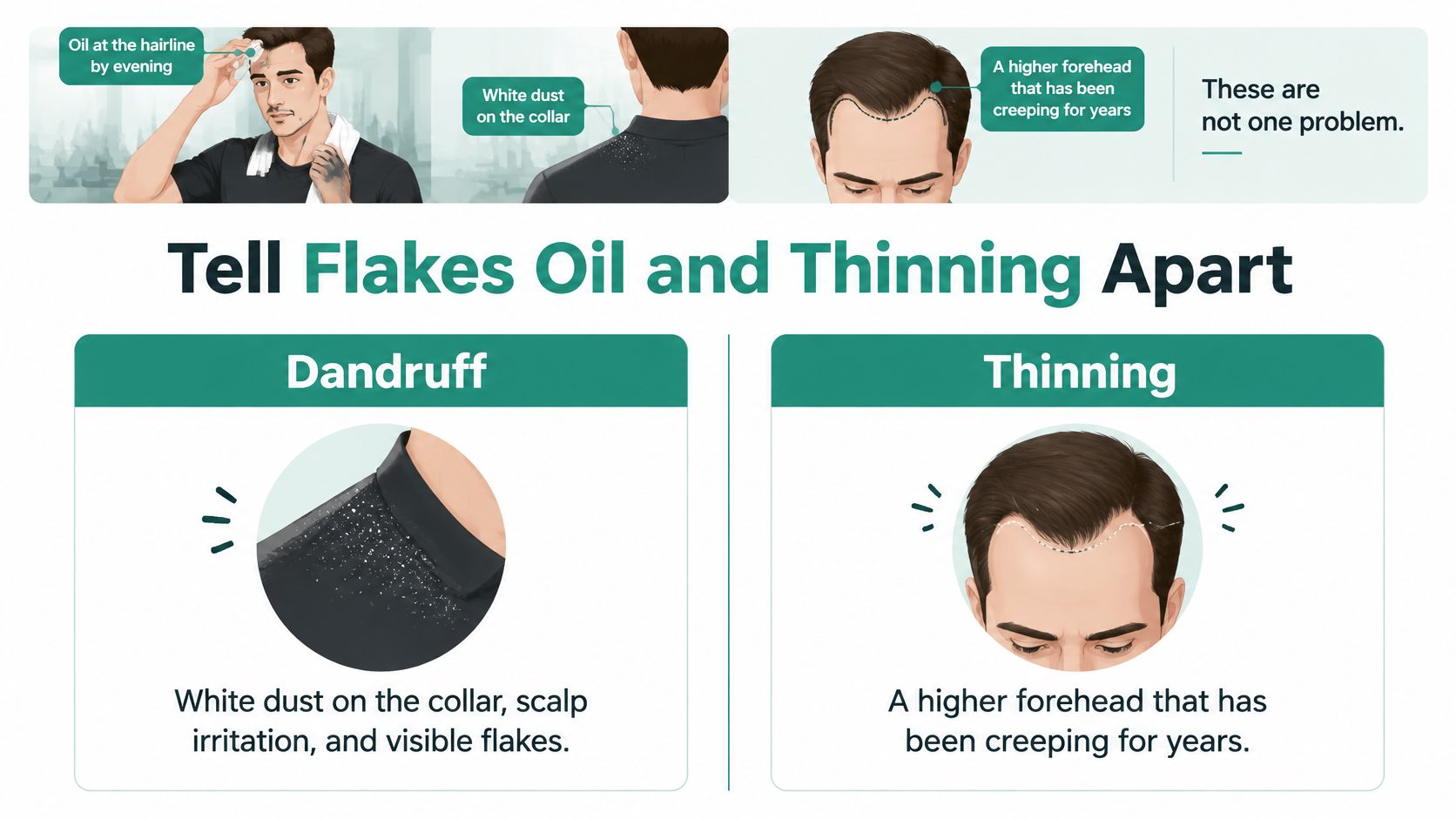
By evening, a man who showered after the gym has oily roots, white dust on his office shirt, and another reason to inspect his hairline in the bathroom mirror. A stronger shampoo seems like the obvious next purchase. But oil, flakes, and a forehead that has slowly become higher don't necessarily have the same cause.
Good scalp care for men starts with separating those signs. A useful routine has a clear job, a wash schedule, enough contact time for the chosen product, and a stopping point when home care isn't helping. A crowded shower shelf can't replace that distinction.
Tell Flakes Oil and Thinning Apart
White flecks on a navy sweater can send a man to the mirror for three different reasons. One scalp is dry after a hot shower. Another is oily and flaking. A third has no flakes at all, just a hairline that has moved back.
Oil at the hairline can reflect normal sebum production. Flakes can come from dandruff, dryness, irritation, or styling residue. Gradual hairline recession raises a separate question about hair loss, even when the scalp looks perfectly calm.
A review of dandruff and seborrheic dermatitis reports dandruff in approximately 50% of adults worldwide and seborrheic dermatitis in approximately 3.0% of men and 2.6% of women across age groups; both conditions appear more often in men than women. The same review separates dandruff, usually visible flaking without substantial inflammation, from seborrheic dermatitis, which can include redness, itching, and inflamed patches.
Similar flakes can need different responses
A dry scalp often feels tight, especially after washing, and may flake without much oil. More aggressive cleansing can leave that scalp feeling worse. Loose flakes mixed with greasy roots suggest a different starting point, although appearance alone cannot establish a diagnosis. The scalp works like a patch of soil: the same dry crumbs on the surface can follow too little moisture, too much oil, or a product sitting on top. The underlying condition decides the response.
Styling residue adds another complication. A man who applies pomade along the front hairline may notice flakes only where that product sits. Removing buildup and reducing leave-in product is more sensible than immediately adding several medicated products.
The table pairs each visible sign with the likely explanation. Start with the name of the problem; the product choice comes after.
What the scalp sign more likely means
| What you notice | More likely explanation |
|---|---|
| Oily skin plus loose white or yellow flakes | Dandruff, sometimes seborrheic dermatitis |
| Tightness and flakes with little oil | Dry scalp |
| Greasy roots a day after washing | Oily scalp, with or without flakes |
| Slow recession at temples or crown over years | Male-pattern hair loss |
| Sudden round patches or handfuls of shed hair | A different shedding problem |
| Thick scale, bleeding, or soreness | Possible psoriasis, infection, or another condition |
| Flakes only where styling product sits | Buildup |
The shedding question needs its own check
The timing of hair loss matters. Gradual recession at the temples or thinning at the crown points toward androgenetic alopecia, while a sudden burst after illness, rapid weight loss, or a stressful period can suggest temporary shedding. Short broken hairs following scratching or an uncomfortable flare raise a different possibility: irritation-related breakage.
Male-pattern loss becomes more common with age and isn't evidence of poor hygiene. A cosmetic shampoo can improve how the scalp looks and feels; it does not treat androgenetic alopecia. A community-based study of men aged 18–49 found moderate-to-extensive hair loss in 42% of participants, which is one reason the hair-loss question deserves attention separately from cleansing.
A guide to dandruff and an itchy scalp can help you describe overlapping symptoms. Persistent pain, sudden patches, bleeding, or rapidly worsening areas need a clinician rather than another shampoo experiment.
Practical rule: Name the main sign before choosing the wash, because a calmer scalp alone does not confirm hair regrowth.
Wash Frequency for Oil Flakes and Thinning
Two men with identical flakes on a dark shirt can need different wash days. One scalp shines by lunchtime, and the flakes look oily and cling near the roots. The other feels tight and dry, with flakes that brush off a shoulder easily. Same visible sign, opposite schedules. The right product on the right schedule usually does more than extra pressure.
How often to wash follows the scalp, not the calendar. The American Academy of Dermatology's dandruff guidance supports frequent cleansing for fine, straight, or oily hair, with dandruff shampoo about twice weekly, while coarse, curly, or coily hair may need medicated shampoo approximately weekly if tolerated. It also separates dry scalp, which may do better with a gentle non-medicated shampoo, from dandruff.
Read "twice weekly" as a count of medicated washes, not a cap on washing. An oily scalp can still be washed every 1 to 2 days: two of those washes use the dandruff shampoo, and the rest use an ordinary one. That split keeps oil, sweat, and styling residue moving without parking an active ingredient on the skin every single day.
A schedule matched to the main concern
The patterns below are starting points, not a way around a product's directions or a dermatologist's advice. The active-flaking and maintenance rows follow treatment guidance, and the wash technique behind them is set out in the next section.
Men's scalp wash frequency by concern and hair type
| Situation | Wash frequency | Product focus | Contact on scalp |
|---|---|---|---|
| Oily, fine or straight hair | Every 1 to 2 days, with the dandruff shampoo on about two of those washes | Anti-dandruff shampoo on the scalp when dandruff is present | About 5 to 10 minutes, or the label time |
| Coarse, curly or coily hair | Medicated shampoo about weekly if tolerated | Scalp only, with conditioner on the lengths | Label time, often about 5 to 10 minutes |
| Active flaking | Daily or every other day when directed and tolerated | Ketoconazole, selenium sulfide or zinc pyrithione | About 5 to 10 minutes, unless the label specifies otherwise |
| Flakes under control | About twice weekly, or the minimum that prevents relapse | Same active, or a different active if control is inadequate | About 5 to 10 minutes, or the label time |
| Dry, tight scalp with little oil | As needed, without daily medicated washing | Mild non-medicated shampoo | Normal short wash unless the label says otherwise |
| Thinning with a calm scalp | A regular schedule that's sustainable | Cosmetic cleanser, with medical care kept separate | Whatever the product label states |
| Thick plaques, bleeding or no change after several weeks | Stop the self-treatment pattern | Clinician assessment | No home timing applies |
A greasy scalp without dandruff doesn't automatically need a medicated cleanser. Ordinary shampoo can do the ordinary but valuable work of lifting oil, sweat, and styling residue. Medication becomes relevant when the symptoms and the diagnosis justify it.
The thinning row deserves its own note. A cosmetic shampoo can improve how the scalp looks and feels, and that is worth having. It does not treat androgenetic alopecia, which needs its own assessment and its own plan.
Hair texture changes the practical routine
For coarse or tightly coiled hair, the scalp and the lengths may want different things. The skin can need dandruff care while the ends need protection from dryness. Parting the hair and applying shampoo straight to the skin avoids soaking the whole hair shaft in a medicated product wash after wash.
For a tight, dry scalp, adding medicated washes can be the wrong move. A gentler cleanser, lukewarm water, and less vigorous washing make a more sensible starting combination. Burning or increased redness after a new product is a reason to stop that product, not to finish an endurance test.
The useful schedule is the least complicated one that leaves the scalp clean and comfortable without creating new dryness.
Give a trial several weeks when symptoms stay mild and the product is tolerated. Swapping shampoos, adding oil, and introducing a scrub in the same week makes it hard to tell what helped. Worsening symptoms override any planned trial period.
How to Wash the Scalp Step by Step
A medicated wash needs deliberate application. The American Academy of Dermatology's seborrheic dermatitis treatment guidance supports applying treatment to affected skin, allowing the prescribed contact time, and adjusting frequency as symptoms settle, commonly from daily or every-other-day use during active disease toward twice-weekly maintenance.
The physical technique should remain gentle. Shampoo needs to reach the skin, but removing flakes doesn't require scraping them loose.
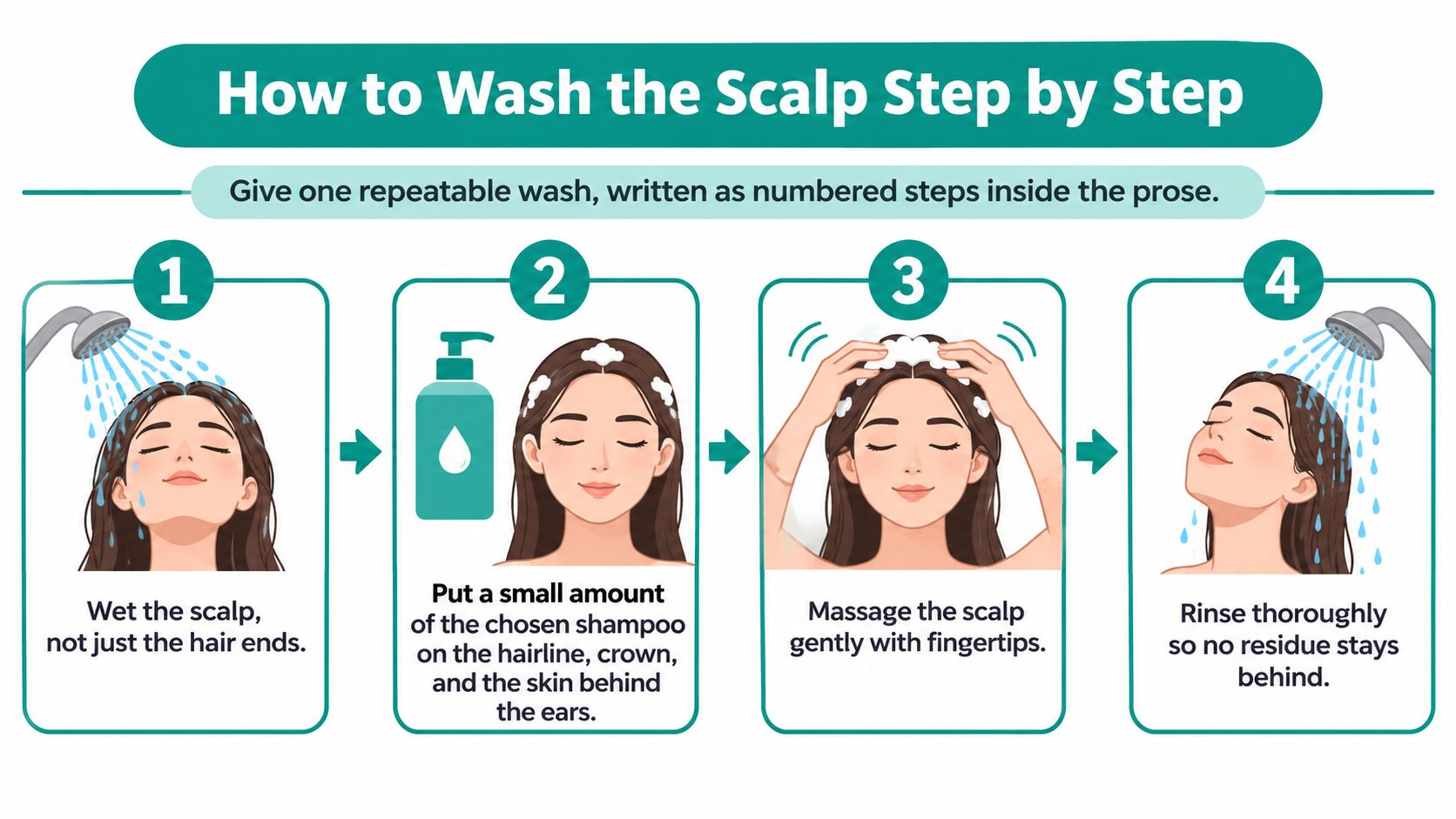
A repeatable wash without scratching
- Wet the scalp, not just the ends. Lukewarm water should reach the roots throughout the head. Thick hair may need separating with the fingers so dry sections aren't missed.
- Place a small amount of the chosen shampoo at the hairline and crown, then distribute it across the affected skin. The areas behind the ears also deserve attention; a flaking beard may need the same approach only when the product's labeling or a clinician permits facial use.
- Massage with fingertips rather than nails. The aim is even coverage, not abrasion. Tender skin needs less handling, and adherent scale shouldn't be picked off.
- Allow the product's specified contact time. The AAD's guide to dandruff shampoo ingredients notes that some products need approximately 5–10 minutes before rinsing and identifies zinc pyrithione, salicylic acid, sulfur, selenium sulfide, ketoconazole, and coal tar as common active categories.
- Rinse thoroughly. Water should pass through the roots as well as the visible hair surface. Residue behind the ears or under dense hair can be easy to miss.
- Conditioner belongs mainly on mid-lengths and ends when those areas feel dry, especially with coarse or curly hair. Heavy conditioner needn't be worked into a flake-prone scalp unless the product is intended for that use.
- Finish with a gentle towel press rather than vigorous rubbing. Tangled lengths should be handled carefully instead of pulled through while wet.
The basic hand movements are straightforward.
Two mistakes that undo a medicated wash
Immediate rinsing shortens the treatment's intended contact with the scalp. Coating the hair shaft instead of the skin misses the area that needs attention. A shower timer and deliberate application are more useful than adding an extra handful of shampoo.
A short contact time from an ingredient study isn't a universal instruction. One randomized trial of a shampoo containing 5% tea tree oil studied 126 participants using a specific formula daily for four weeks, with a related clinical summary describing a three-minute contact time. That protocol doesn't establish the timing or effectiveness of other tea-tree shampoos.
When an active ingredient provides inadequate control, switching or alternating active categories can be reasonable. These are medicated dandruff approaches, not evidence that a cosmetic brand treats a scalp condition. Persistent thick plaques, bleeding, or failure despite appropriate use calls for assessment.
For cleanser preferences, an explanation of sulfate-free shampoo can help distinguish formulation choices from medical needs. Sulfate-free doesn't automatically mean safer, and conventional cleansers aren't unsuitable by default.
ProMD Health's overview of scalp care for thinning hair provides additional context for separating cleansing from hair-loss care. A useful wash week means less visible buildup, better comfort, and no new soreness, not proof of increased density.
Where GrowActive Fits Beside Medical Care
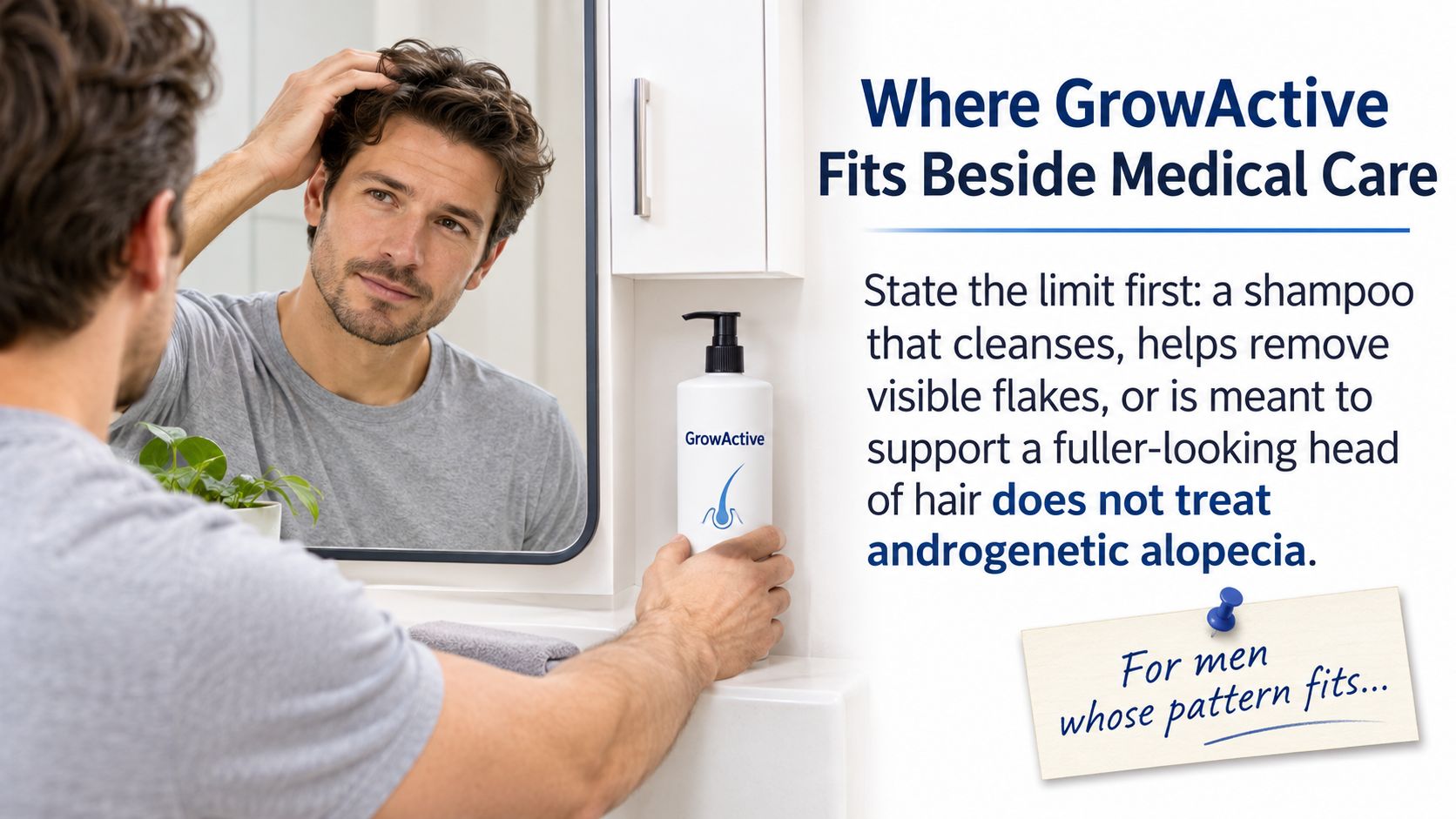
A man spots a thinner-looking crown in the bathroom mirror and reaches for a shampoo. A cosmetic wash can support scalp cleansing and hair's appearance, while androgenetic alopecia calls for diagnosis and appropriate medical care.
Medical options have a different timeline
For appropriate adult men, the European dermatology guideline on androgenetic alopecia identifies topical minoxidil and oral finasteride as established options. It notes that 5% minoxidil is generally more effective than 2%, and that finasteride is typically prescribed at 1 mg daily. The guideline also discusses a randomized 12-month comparison involving 428 men, reporting regrowth results of 80.5% with oral finasteride, 59.0% with topical minoxidil, and 94.1% with both treatments.
Hair-loss options compared in one study
| Option | Reported regrowth | Practical note |
|---|---|---|
| Oral finasteride, 1 mg daily | 80.5% | Clinician-prescribed; sexual and mood-related effects need counseling |
| Topical minoxidil, 5% generally more effective than 2%; comparison-study concentration not specified here | 59.0% | Apply to a dry scalp as directed; early shedding can occur |
| Oral finasteride with topical minoxidil | 94.1% | More treatment burden and potential adverse effects |
| Cosmetic shampoo alongside medical care | No regrowth figure | Scalp cleansing as part of a routine |
These figures come from one comparison, so they are not a promise of an individual result. The cosmetic shampoo row clarifies its separate role; shampoo was not a treatment arm in the study. Treatment choices depend on medical history, preferences, tolerance, and willingness to continue.
Assessment generally takes roughly 6–12 months under the cited guideline. Consistent photographs of the hairline and crown can help a clinician assess changes without shifts in lighting or styling obscuring them.
Minoxidil is applied to a dry scalp, not mainly to the hair. Early shedding or irritation can make treatment harder to continue. Discuss troublesome changes with a clinician. Finasteride also calls for counseling about possible sexual and mood-related effects.
A cosmetic wash remains a separate choice
One option is Sphagnum Botanicals' GrowActive Natural Hair Growth Shampoo with Peat Mud for Men, a daily cosmetic shampoo containing Nordic peat and positioned for thicker, stronger-looking hair with regular use. It provides the wash step alongside appropriate medical care.
Peat is a distinctive cosmetic ingredient and a natural source of humic substances. Ingredient research on a different formula does not establish how this finished shampoo performs. Natural ingredients are not automatically gentler or more effective.
The FDA's explanation of cosmetics law describes how claims to treat disease or affect body structure or function can bring a product under drug requirements. A product name containing growth language is not clinical proof. Check the shampoo label for directions and follow its stated contact time.
A guide to hair-growth products for thinning hair can help sort product categories before a consultation. Men considering in-clinic procedures can discuss PDGF therapy for men's hair loss with a qualified clinician.
Keep One Routine You Can Repeat
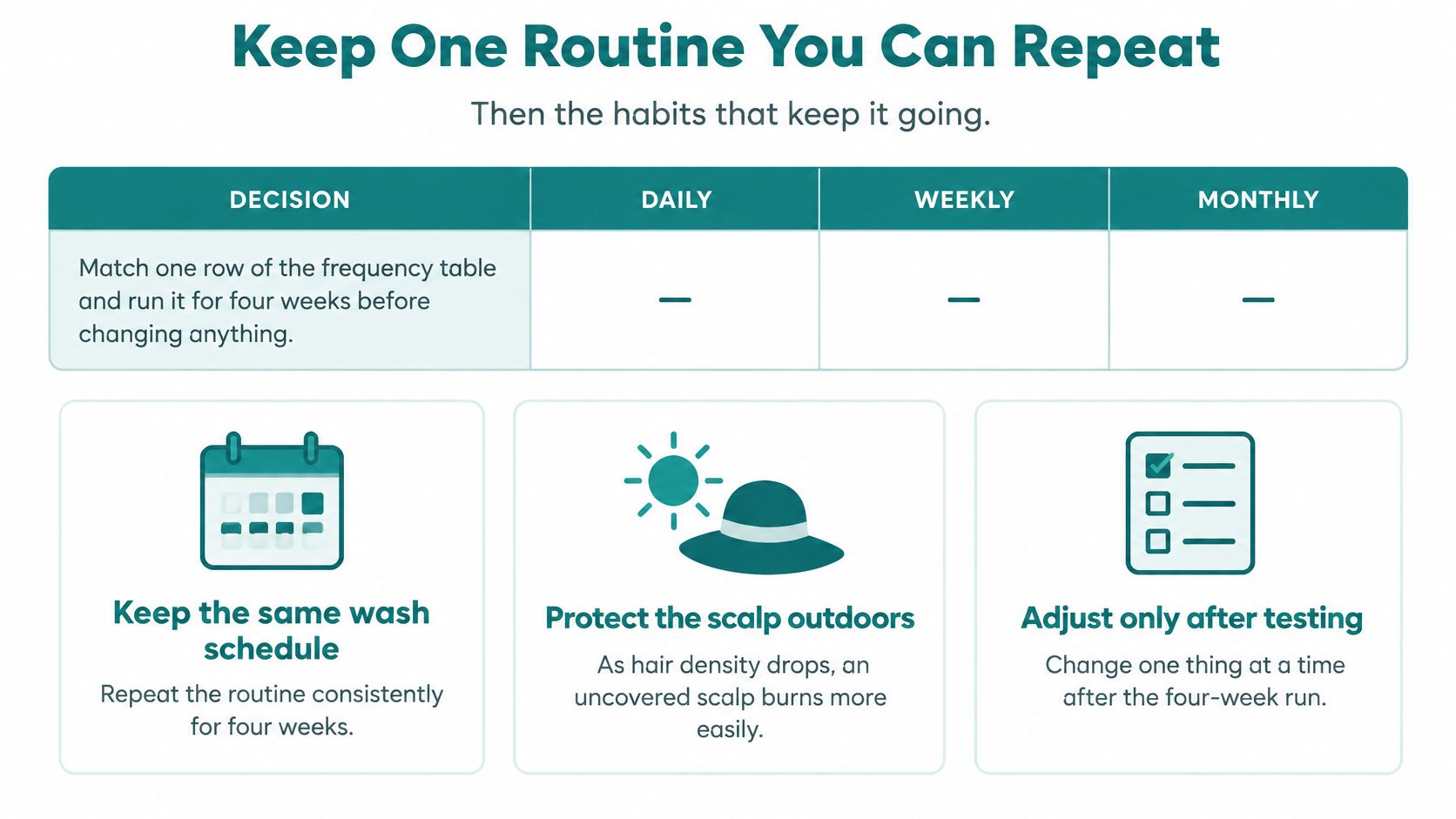
A logged week can look plain: Monday, wash with the medicated shampoo, follow the label contact time, no burning. Thursday, rinse after the gym. Sunday, a photo in the same light. That record does more than a shelf of half-used bottles because it ties one concern to one wash schedule and one stop rule.
Match the main concern to a wash row and keep that routine steady for four weeks, as long as symptoms stay mild and the product is tolerated. Four weeks is an organizational commitment; it does not promise resolution in that window. The calendar should list the cleanser, wash days, label contact time, and a clear stop rule. A clinician can then see what was tried and for how long.
Small habits that make the plan workable
- Outdoor protection: A hat covers exposed crown and receding hairline areas. A broad-spectrum sunscreen can be applied to exposed scalp according to its label.
- Workout rinsing: Sweat can justify a rinse or ordinary cleansing without adding another medicated treatment.
- Beard coverage: When facial use is permitted, treatment should reach the skin beneath the beard rather than stopping at the sideburns.
- Cleaner contact surfaces: Wash hat linings, helmet padding, and pillowcases regularly to reduce oil and styling residue against the scalp.
- Lighter styling: Use less product at the roots so buildup is easier to manage, and keep conditioner on dry lengths.
These habits support the chosen routine without creating a second treatment shelf.
Thinning is not a trivial concern. A 2025 survey of 71 male university students found 40% reporting thinning, 44% a receding hairline, and 14% a bald spot, while more than half would consider taking hair-loss treatments indefinitely. That small student sample does not describe every man, but it shows why maintenance deserves an honest conversation. A routine that creates anxiety, takes too much effort, or changes constantly is hard to sustain. Fewer well-chosen steps leave more attention for symptoms and medical follow-up.
One primary job and a firm stop rule
For an oily, flaky scalp, the primary job is consistent dandruff care. For a dry, tight scalp, it is gentler cleansing without reflexively increasing medicated use. For gradual recession, the useful commitment is a diagnostic appointment and a consistent photo record.
Heavy visible scale may make PsoriAid+ Shampoo relevant as a labeled scalp-cleansing option containing 3% salicylic acid, peat, and menthol. Its approved directions should determine use. Salicylic acid does not justify inventing additional disease-treatment claims. Thick, painful, or bleeding plaques still require assessment.
Stop rule: Pain, bleeding, sudden patches, infection-like changes, rapid worsening, or persistent symptoms despite appropriate care end the shampoo experiment.
Don't wait out the calendar trial if a product burns, swells, or makes redness worse. Persistent shedding also deserves attention even when flakes improve. Comfort, visible cleanliness, and hair retention are different outcomes.
If warning signs appear, book an appointment right away. At the end of the planned trial, a stable but unimproved scalp calls for assessment or one deliberate adjustment. A second shampoo, a new supplement, and a different styling product added in the same week make the next appointment harder to read. The repeatable routine is the point: one schedule, its contact time, and its stop rule written beside it.