

Up to 80% of men and 50% of women by approximately age 70 may experience androgenetic alopecia, the common pattern of progressive thinning. Hair growth products for thinning hair can improve how the hair and scalp look and feel, but cosmetic products shouldn't be confused with medical treatments that may support regrowth.
You may have noticed more strands on your pillow, a wider part under bright light, or a thicker ring of hair around the drain. The practical question usually isn't whether a shampoo smells pleasant. It's whether anything can help the hair grow back, or whether it will only make existing strands look fuller.
That distinction matters. Shampoos, conditioners, masks, styling products, and cosmetic serums can improve cleansing, conditioning, manageability, breakage, and visual coverage. They can't be assumed to reverse follicle miniaturization, and they shouldn't replace a clinical assessment when loss is sudden, patchy, painful, or progressing quickly.
Noticing Thinner Hair and What You Might Be Looking For
A useful first step is to separate appearance from follicle activity. A conditioner may give fine strands more slip and reduce the friction that contributes to breakage. A volumizing formula may make the hair stand farther away from the scalp. A scalp product may leave the skin feeling cleaner or more comfortable. Those results can be worthwhile, but they aren't the same as producing new terminal hairs.
The question behind the product search
If your hair still grows but individual strands feel finer, cosmetic care may improve the way your existing coverage looks. If the part continues to widen or the hairline steadily recedes, the concern may involve a progressive form of hair loss that needs more than a change in cleanser.
This guide compares shampoos, conditioners, leave-in products, scalp serums, masks, and styling aids. It also explains how to judge timelines, when a routine is reasonable, and when adding another product is less useful than seeking a diagnosis.
Practical rule: A fuller-looking result is a cosmetic outcome. Regrowth is a medical claim that requires evidence for the specific treatment and condition.
Some people also use temporary appearance solutions while they assess what is happening. If you're considering added hair rather than a treatment product, this guide to the best hair extensions for fine hair offers context on choosing options that suit finer hair. Extensions can change visible volume, but they don't address why density is changing.
The right expectation is modest but useful. A routine can help you maintain a comfortable scalp, reduce avoidable breakage, and make the hair you have look more substantial. It can't promise that an inactive follicle will restart, and a product page shouldn't imply otherwise.
Why Hair Thins in the First Place
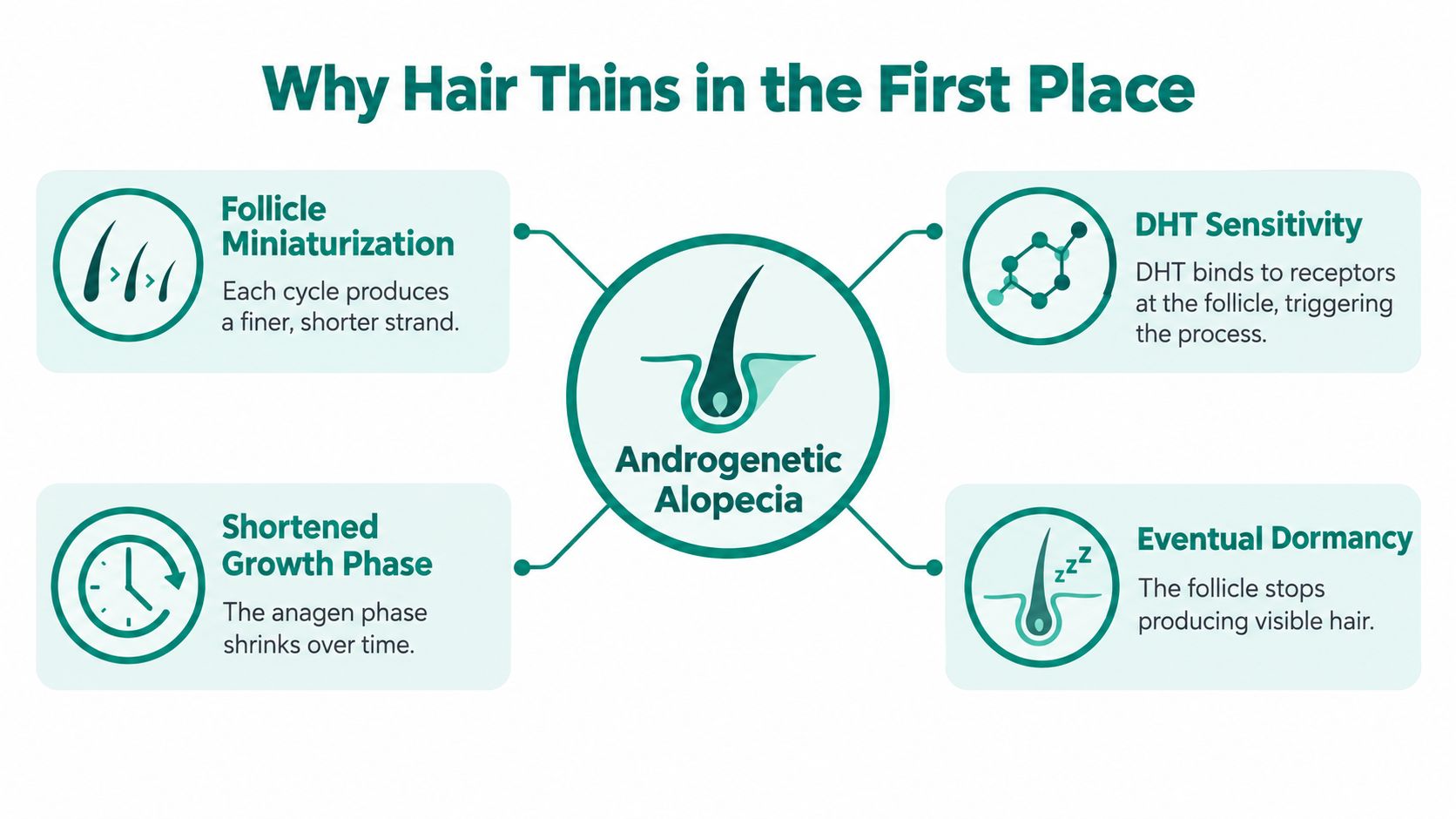
Androgenetic alopecia, commonly called pattern hair loss, is the dominant form of progressive thinning. In genetically susceptible follicles, sensitivity to dihydrotestosterone, or DHT, causes gradual miniaturization in particular scalp areas. Each cycle may produce a shorter, finer strand, until the follicle becomes clinically inconspicuous. This biology explains why a cosmetic thickening effect shouldn't be presented as reversal of the condition. Clinical review of androgenetic alopecia
Gradual pattern or sudden shedding
Not every increase in shedding is pattern hair loss. Telogen effluvium can cause more widespread shedding after an illness, major stress, hormonal change, or medication change. Nutritional problems, postpartum shifts, and repeated tension or harsh styling may also contribute to hair changes. These possibilities can look similar to a consumer, while the sensible response may be different.
Look at the pattern rather than counting every strand. Gradual recession at the front, thinning around the crown, or a widening central part can fit a patterned process. A sudden increase in shedding across the whole scalp may point toward an event that deserves assessment, especially if it continues.
A broader educational overview of possible causes is available in this Georgia Plastic hair loss guide. It can help you organize what you've noticed before discussing it with a healthcare professional.
What a cleansing product can realistically contribute
A daily shampoo containing Nordic peat mud, tea tree oil, and panthenol can be positioned as scalp and hair care, with a focus on cleansing and a thicker, stronger-looking appearance. The Natural Hair Growth Shampoo with Nordic Peat Mud & Tea Tree Oil is described as SLS/SLES free and suitable for daily use across hair types. Its formula description doesn't establish that the finished shampoo treats androgenetic alopecia or reverses follicle miniaturization.
GrowActive products featured in this guide

A rinse-off cleansing step for the scalp and roots. |

GrowActive Shampoo + Conditioner Set Choose the set variant for a paired wash and conditioning routine. |

A leave-on scalp-care step; follow the product directions. |
That distinction is important because peat and its humic substances can be discussed as cosmetic ingredients without transferring claims from ingredient research to a finished product. A clean-feeling scalp and better-manageable fiber may support a routine, but the product category remains different from an established medical treatment.
Product Categories and What Each One Actually Does
A thinning-hair routine works better when every step has a defined job. Shampoo mainly contacts the scalp and is rinsed away. Conditioner works mostly on the hair fiber, where it improves slip and surface feel. A leave-in or serum stays in place longer, but longer contact alone doesn't prove a stronger medical effect.
Match the category to the problem
Shampoo is the foundation for cleansing sweat, oil, flakes, and buildup. It may support a cleaner-looking scalp and can make the roots feel lighter, but brief rinse-off contact limits what you should expect from it.
Conditioner is most useful on the lengths and ends. By reducing friction and improving manageability, it may help fragile hair look smoother and reduce the rough feel that makes fine strands seem less dense.
Masks provide a more concentrated conditioning step. They can be useful when the fiber feels dry, coarse, or prone to breakage. Keep rich formulas mainly on the lengths if the roots become weighed down easily.
Scalp serums are leave-on products applied directly to the scalp. Their role depends on the formula, and a cosmetic serum should be described around scalp care or fuller-looking hair unless the finished product has appropriate clinical evidence.
Styling volumizers change appearance immediately by adding texture, lift, or separation between strands. They don't alter follicle biology, but they can be practical on days when visual coverage matters.
For a broader discussion of cleansing and thickness, see this guide to choosing shampoo for hair growth and thickness. Supplement discussions should also be handled carefully, since a clinical overview of hair supplements shouldn't be read as proof that every supplement suits every cause of thinning.
Product Categories at a Glance
| Category | Targets | Typical Use | Realistic Outcome |
|---|---|---|---|
| Shampoo | Scalp and roots | According to cleansing needs and label directions | Cleaner-feeling scalp, lighter roots, fuller-looking hair |
| Conditioner | Hair shaft | After shampooing, mainly on lengths | Better slip, manageability, and reduced friction |
| Mask | Mostly hair shaft, sometimes scalp depending on label | Occasional conditioning step | Softer-feeling, smoother, less brittle-looking hair |
| Scalp serum | Scalp | Leave on according to product directions | Scalp-care support or fuller-looking appearance |
| Styling volumizer | Hair shaft and root appearance | When styling | Immediate visual lift and coverage |
| Medical treatment | Follicles and the underlying diagnosis | Under appropriate directions and supervision | Possible slowing or regrowth outcomes that require evidence |
The table also shows why stacking every category can create confusion. If you change shampoo, serum, mask, supplement, and styling routine at the same time, you won't know which step caused an improvement, irritation, or no result.
Active Ingredients Worth Knowing
The clearest dividing line is between medical actives and cosmetic ingredients. Topical minoxidil is the principal FDA-approved pharmacological option for androgenetic alopecia in both men and women. Oral finasteride is approved for men. Those approvals apply to the drugs and their intended uses, not to every shampoo, botanical serum, or peat-based formula. Review of minoxidil and finasteride milestones
Medical, clinician-guided, and cosmetic tiers
Topical minoxidil belongs in the medical-treatment category. The American Academy of Dermatology explains that it can help with early hair loss, but it can't restore an entire head of hair, and visible improvement commonly requires approximately 6 to 12 months of continuous use. AAD guidance on hair-loss diagnosis and treatment
Finasteride is an oral 5-alpha-reductase inhibitor used for male pattern hair loss. Because treatment choice depends on sex, medical history, risks, and goals, it shouldn't be treated as an interchangeable add-on to a cosmetic routine. Compounded topical finasteride also isn't automatically risk free. The FDA safety alert on compounded topical finasteride notes that systemic absorption can occur.
Low-dose oral minoxidil and other prescription or off-label approaches require clinician guidance. A medicated shampoo may have a specific scalp-care role, but it should not inherit the regrowth evidence of oral or topical drugs merely because both appear in a search result.
Ingredients such as caffeine, biotin, niacinamide, saw palmetto, pumpkin seed oil, rosemary oil, peptides, and marine complexes are often marketed for thinning hair. Proposed explanations include scalp conditioning, support for the hair fiber, effects on microcirculation, or interference with pathways associated with DHT. Those proposed mechanisms don't establish that a finished cosmetic product regrows hair in people with androgenetic alopecia.
Tea tree oil is another frequently discussed cosmetic ingredient. This overview of tea tree oil in scalp care should be read as ingredient education, not as evidence that every product containing it treats hair loss.
Active Ingredients for Thinning Hair by Evidence Tier
| Ingredient | Category | Proposed Mechanism | Evidence Status |
|---|---|---|---|
| Topical minoxidil | FDA-recognized medical treatment | Supports follicle growth signaling | Established treatment evidence for relevant pattern hair loss |
| Oral finasteride | FDA-recognized medical treatment for men | Inhibits 5-alpha-reductase activity | Established use for male pattern hair loss, with medical precautions |
| Low-dose oral minoxidil | Clinician-guided treatment | Pharmacological support for hair growth | Requires medical assessment and monitoring |
| Ketoconazole shampoo | Medicated scalp product | Scalp-care role depending on diagnosis and label | Not a substitute for diagnosing patterned loss |
| Caffeine and botanical oils | Cosmetic or botanical | Proposed follicle or scalp effects | Evidence varies and shouldn't be transferred to every formula |
| Biotin and peptides | Cosmetic or supplement-related | Fiber support or proposed signaling | Not equivalent to drug-level evidence for follicle miniaturization |
| Marine complexes and saw palmetto | Supplement or botanical | Proposed nutritional or DHT-pathway effects | Product-specific evidence and medical context matter |
If a product makes a medical regrowth promise, ask whether the finished formula, not merely one ingredient, was studied for the condition being discussed.
Realistic Timelines and What Results Actually Look Like
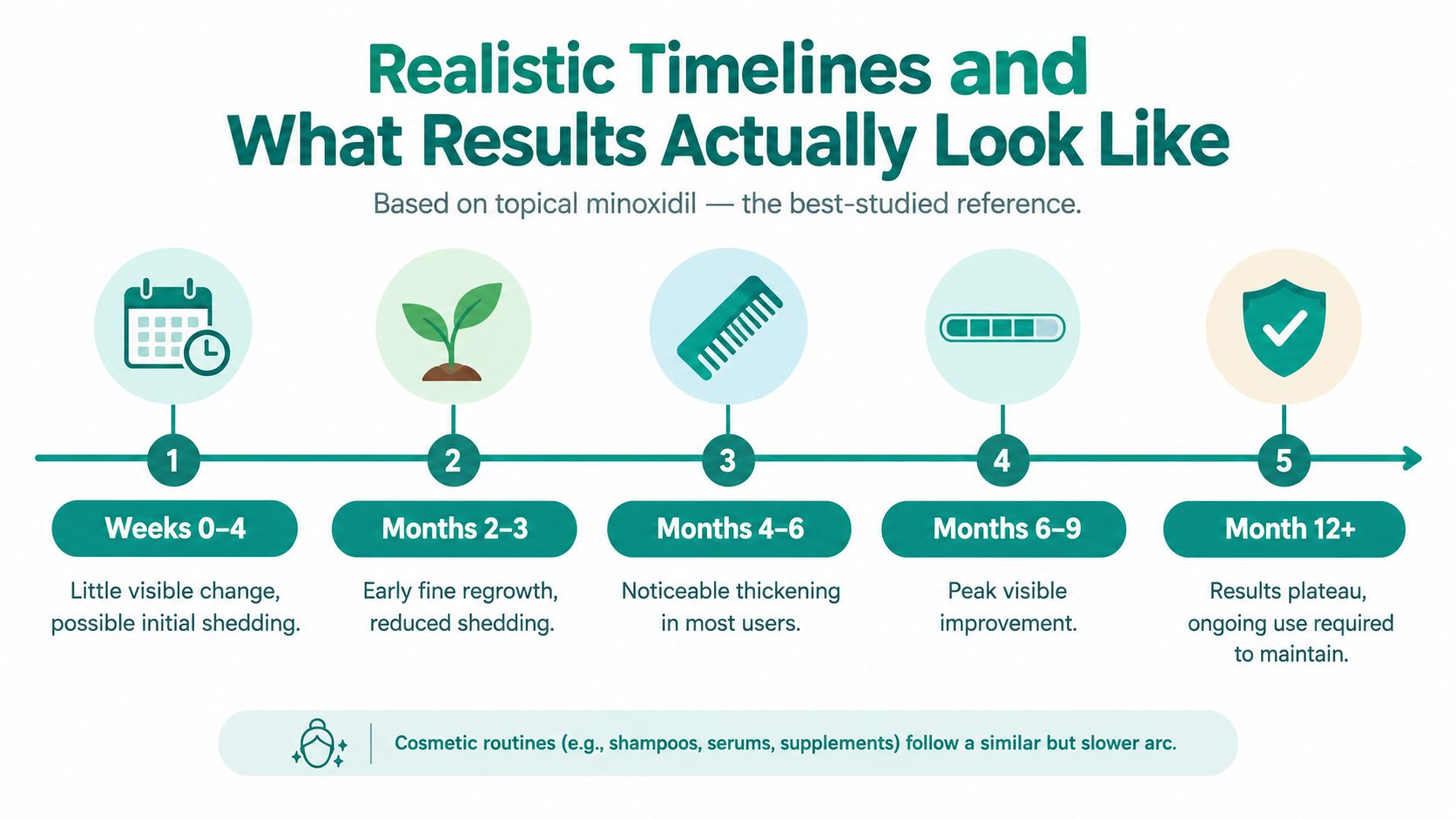
Minoxidil provides the clearest reference point for setting expectations. The American Academy of Dermatology states that many people need approximately 6 to 12 months of continuous use before judging visible improvement. The DailyMed label for 5% topical minoxidil foam says some users may see results as early as 2 months, while some men need at least 4 months, and it advises consulting a physician if there are no results after 4 months. DailyMed minoxidil foam label
How to read the calendar
During the early weeks, a cosmetic routine may produce little visible difference. Cleansing and conditioning effects can be immediate, while changes in density require much longer observation. With medical treatment, early shedding can also complicate interpretation, so a few days of extra hair in the brush shouldn't automatically be labeled failure.
At the 2-to-4-month checkpoint, ask whether shedding, scalp comfort, breakage, and styling behavior have changed. At the 6-to-12-month checkpoint, compare standardized photographs and the width of the part rather than relying on memory. The DailyMed label also states that newly regrown hair can be lost in about 3 to 4 months after minoxidil is stopped, which illustrates why maintenance matters for recognized treatments.
Cosmetic-only products should be judged more modestly. Fuller-feeling strands, improved manageability, less breakage, and better visual coverage are reasonable cosmetic endpoints. New terminal growth shouldn't be assumed without product-specific clinical evidence.
The underlying cause changes the timeline. A temporary shedding event may behave differently from progressive miniaturization, and postpartum or traction-related changes need their own assessment. If density continues to decline, don't keep extending a cosmetic trial indefinitely.
Building a Routine That Makes Sense
A useful routine is one you can follow and evaluate. Start with cleansing that suits your scalp and hair texture, then add only the steps that solve a specific problem. A leave-on serum, for example, belongs on a clean or towel-dried scalp if its directions call for that placement, while a leave-in conditioner usually belongs on the lengths.
Layer by location
Apply scalp-focused products before products intended for the hair shaft. This prevents a heavy conditioner or styling film from becoming the first layer on the scalp. If you use heat, place heat protection after the leave-in step and follow the product label.
Masks need a clear purpose. A formula aimed at conditioning may help dry-feeling lengths, while a strengthening-focused product may suit hair that breaks easily. Neither category should be presented as a treatment for follicle miniaturization.
Try one major change at a time. Use consistent lighting, keep the part in the same position, and take dated photographs from comparable angles. Daily shedding counts are difficult to interpret, so combine them with signs such as breakage, hair diameter, scalp visibility, and styling ease.
Sample Weekly Routine for Thinning Hair
| Step | When | Product Role |
|---|---|---|
| Gentle shampoo | On regular wash days | Cleanses the scalp and roots without making cosmetic promises about regrowth |
| Conditioner | After shampooing | Improves slip and manageability on the lengths |
| Scalp serum | On designated days, before styling | Provides leave-on cosmetic scalp care when the formula suits the user |
| Hair mask | Occasional routine step | Adds conditioning for dry or breakage-prone lengths |
| Progress photographs | At consistent intervals | Tracks visible change more reliably than memory |
| Clinician review | When loss is progressive or unusual | Investigates diagnosis and treatment options |
A structured scalp-care routine can help you assign each step a place instead of applying several unknown actives together. Simplify if the scalp becomes uncomfortable, if buildup increases, or if you can't tell which product is responsible for a reaction.
Red Flags That Mean You Should See a Clinician
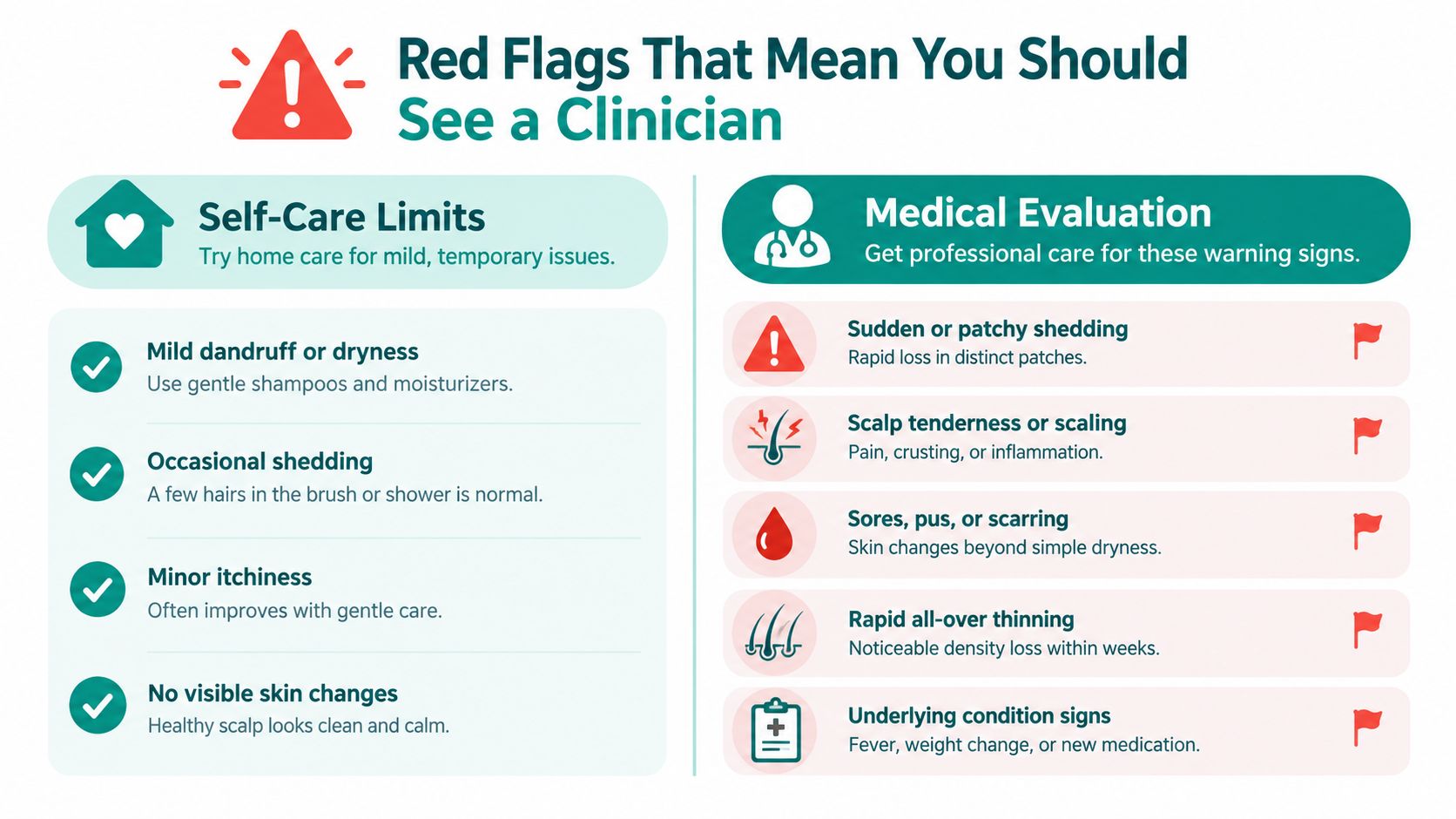
A cosmetic routine is reasonable for mild concerns that appear stable and don't come with alarming scalp changes. It becomes the wrong first response when loss is sudden, patchy, rapidly progressive, painful, or associated with visible skin changes.
Seek assessment when the pattern changes
Arrange a clinical evaluation for:
- Sudden or patchy loss: Distinct areas of loss don't fit neatly into a standard cosmetic-thinning routine.
- Tenderness, scaling, or marked redness: Painful or visibly inflamed skin needs assessment rather than repeated product experimentation.
- Sores, crusting, pus, or scarring: These changes go beyond ordinary concerns about hair texture or volume.
- Rapid all-over thinning: Noticeable density loss over a short period can have several possible causes.
- Relevant health changes: A new medication, significant illness, hormonal change, or other systemic symptom should be part of the history.
Persistent shedding also deserves attention, especially when it doesn't settle or when the frontal hairline keeps receding. In women, thinning alongside irregular cycles, acne, or increased facial hair can justify discussion of hormonal causes. A clinician may consider the history, scalp examination, trichoscopy, and blood tests for nutritional, thyroid, or hormonal contributors when appropriate.
The reason to seek help early isn't to create alarm. Different forms of alopecia can require different responses, and a systematic review found that combination regimens involving minoxidil and approaches such as low-level light therapy or microneedling outperformed minoxidil alone in relevant comparisons, while also emphasizing the need to consider evidence and safety. Systematic review of combination treatment for androgenetic alopecia
Don't use that finding to justify unsupervised microneedling or device stacking. Diagnosis, technique, infection control, and the actual device or treatment all affect the risk and potential value.
Putting It All Together
Hair growth products for thinning hair fall into two practical groups. Cosmetic products can support cleansing, conditioning, reduced breakage, manageability, and a fuller-looking result. Medical treatments address diagnosed hair loss with evidence and precautions that shouldn't be borrowed by a shampoo, conditioner, mask, or botanical serum.
Choose a simple routine you can sustain. Gentle cleansing, appropriate conditioning, a carefully selected leave-on product, and occasional fiber care may improve the appearance of existing hair. Use consistent photographs and allow a realistic observation period before deciding whether the cosmetic result is useful.
If the part keeps widening, the hairline recedes, or shedding accelerates, buying more products isn't the highest-yield next step. Seek a qualified clinician who can distinguish androgenetic alopecia from other causes and discuss evidence-based options, including minoxidil where appropriate. The decision threshold is straightforward: use cosmetic care for support and appearance, and seek medical care for diagnosis and possible regrowth treatment.
Choose the fewest products that address your actual scalp or hair-fiber needs, follow their labels, and record dated photographs in consistent lighting. If your density continues to decline or your scalp develops pain, scaling, sores, or patchy loss, book a professional evaluation instead of escalating the routine on your own.