

You're standing in the shampoo aisle with flakes on your shoulders, a scalp that won't stop itching, and a bottle in hand that promises relief because it contains tea tree oil. The label sounds reassuring, but the core question is simpler, and harder, can this bottle help your scalp, or is it just scented marketing?
An anti dandruff shampoo with tea tree oil can be a useful option, but only if you understand what you're buying. The goal is not to chase the loudest claim on the shelf, it's to read the formula the way a formulator would, so you can judge whether the shampoo has the right active, the right base, and the right level of gentleness for your scalp.
Why Tea Tree Oil Keeps Showing Up in Anti-Dandruff Shampoos
The reason tea tree oil keeps coming back is practical. People who deal with flakes often want something that feels less clinical than a medicated shampoo, and brands know that a botanical active can make the bottle feel more approachable without giving up the anti-dandruff category altogether.
Tea tree oil also brings a familiar sensory profile, a sharp, clean scent that many shoppers associate with “fresh scalp” even before they look at the ingredient list. That matters in the aisle, because a shampoo has to be chosen before it can be judged. If the first wash feels harsh or smells overly medicinal, people often stop using it.
What the shelf is really telling you
A tea tree shampoo is usually trying to solve two problems at once, visible flaking and the uncomfortable scalp feeling that often comes with it. That doesn't make it a miracle fix. It just means the ingredient has enough staying power in the category to keep earning space on bottles.
A simple way to think about it is this, tea tree oil tends to appeal when a shopper wants a botanical active, a rinse-off format, and a formula that can fit into a regular routine. That's why it shows up in both sulfate-free and more traditional cleansing systems.
Practical rule: if a bottle leans hard on the phrase “natural” but won't tell you the active level or how often to use it, treat that as a sign to keep reading, not to buy faster.
The rest of the label matters more than the marketing language. If you know what to look for, you don't need to trust the front of the bottle.
What Tea Tree Oil Actually Is and What the Evidence Shows
Tea tree oil is a volatile essential oil steam-distilled from the leaves of Melaleuca alternifolia, a plant native to Australia. In cosmetic products, its best-known active component is terpinen-4-ol, which is linked to antimicrobial activity and the scalp-cleansing reputation that keeps tea tree oil in dandruff formulas.
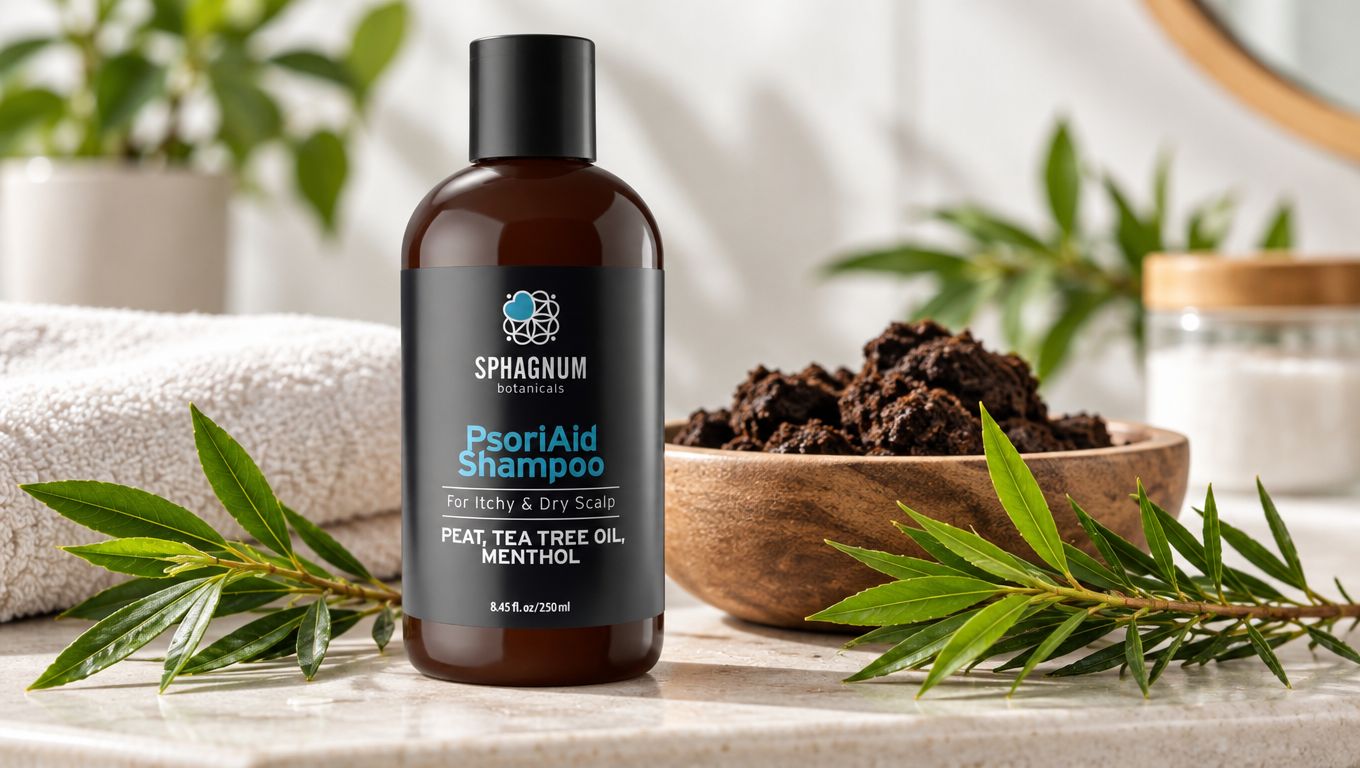
Cosmetic-grade tea tree oil in shampoos is usually standardized, and that standardization is part of why formulas can be compared at all.
One Sphagnum Botanicals product that fits this conversation is PsoriAid Shampoo with Tea Tree Oil & Peat – Relieves Itching & Redness on Psoriasis-Prone, Sensitive Scalp, Daily Use, a daily shampoo described as a gentle option for flaky and itchy scalps with Nordic peat mud and tea tree oil, free from harsh sulfates and suitable for sensitive and colour-treated hair.
Tea tree oil has real evidence behind it, but the strongest practical reading is this, it's a moderately supported active for flaky scalps, not a substitute for prescription-strength antifungals when the condition is stubborn or severe.
For a deeper ingredient overview, the internal guide on tea tree oil benefits at https://sphagnumbotanicals.com/blogs/news/tea-tree-oil-benefits-2 gives helpful background on how the ingredient is positioned in scalp care.
A quick evidence snapshot
The most useful takeaway from the research is narrow and practical. Tea tree oil shampoos appear to work best when they're used consistently, at a clearly stated concentration, in a rinse-off format. That's a very different claim from “natural dandruff cure,” and the difference matters when you're deciding what to buy.
The evidence is thinner on long-term maintenance. That means you should treat tea tree oil as part of a routine, not as a one-time rescue.
How a Tea Tree Oil Anti-Dandruff Shampoo Works on the Scalp
A good tea tree shampoo isn't just “oil in a bottle.” It works through a combination of scalp effects, and the formula decides how well those effects show up in real life.
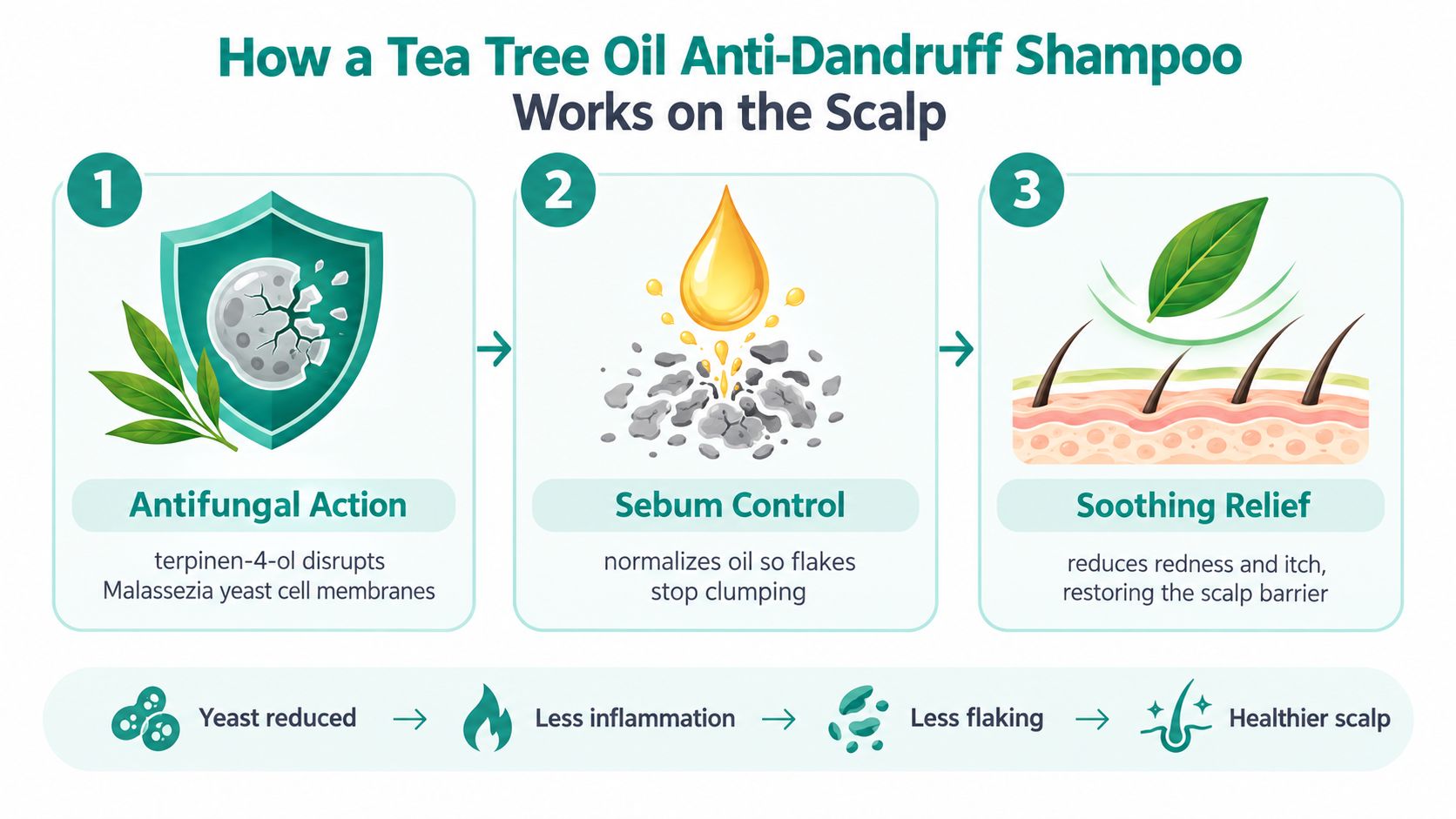
First, it targets the scalp yeast that worsens flakes
Dandruff often involves Malassezia, a yeast that lives on the scalp and can become part of the flake cycle in susceptible people. Tea tree oil's active fraction, especially terpinen-4-ol, is thought to help by interfering with yeast growth, which is why the ingredient keeps appearing in anti-dandruff formulas.
That doesn't mean every scalp flake is caused by the same mechanism. It does mean that if your dandruff is yeast-associated, a tea tree shampoo may address part of the problem rather than only masking the symptom.
Then, it can reduce the itch-scratch loop
Once the scalp starts itching, people scratch, and scratching creates more irritation. A well-formulated tea tree shampoo can help calm that cycle because the scalp feels less reactive after regular use.
That calming effect is one reason people describe tea tree shampoos as “freshening” or “resetting.” The benefit isn't just cosmetic, it can make the scalp easier to leave alone.
Finally, the base formula decides whether it helps or backfires
The ingredient list below the tea tree oil matters. Surfactants, pH, and companion ingredients determine how much oil reaches the scalp, how long it stays in contact, and whether the wash leaves the scalp stripped or comfortable.
A harsh cleansing base can make the scalp feel worse even if the active is sound. A gentler base can make the whole product more usable, especially for people who already feel tightness after washing.
The infographic above shows the basic logic clearly, yeast reduced, inflammation calms, flakes loosen, scalp comfort improves. The trick is that the bottle has to support that sequence instead of fighting it.
Tea Tree Oil Compared With Other Anti-Dandruff Actives
Tea tree oil sits in a middle ground. It's not the strongest anti-dandruff active available, but it's also not just a fragrance ingredient. That's why it often makes sense for people with mild to moderate dandruff, or for anyone who wants a botanical-leaning option that still has clinical support.
| Tea Tree Oil vs Common Anti-Dandruff Actives | Mechanism | Evidence Strength | Onset of Results | Irritation Risk | Best For |
|---|---|---|---|---|---|
| Tea tree oil | Botanical antimicrobial support, soothing effect | Moderate | Gradual, with consistent use | Can irritate sensitive scalps | Mild to moderate dandruff, botanical preference, maintenance |
| Ketoconazole | Potent antifungal action | Stronger medical evidence | Often faster when yeast-driven dandruff is stubborn | Can feel drying for some users | Persistent dandruff, seborrheic dermatitis |
| Zinc pyrithione | Mainstream anti-dandruff benchmark | Widely established in anti-flake care | Usually steady with repeated use | Generally tolerated, but formula matters | Everyday anti-dandruff routines |
| Selenium sulfide | Anti-yeast and scalp-normalizing action | Established for dandruff care | Can be effective when used correctly | Can be more irritating in some formulas | Oily, stubborn flaking |
| Salicylic acid | Descaling, helps lift built-up flakes | Best as a support ingredient | Works by loosening scale rather than treating yeast | Can be drying if overused | Thick scale, buildup, combination routines |
The main comparison point is simple, tea tree oil can help, but it usually isn't the most aggressive choice. That makes it useful for people who want something gentler, or who notice that heavy medicated formulas are too much for regular use.
Where salicylic acid fits
Salicylic acid is often better understood as a descaling partner. It helps loosen stubborn buildup so other ingredients can do their job, which is why it often appears in shampoos aimed at thicker scale.
An internal guide on shampoo with salicylic acid is useful if you're trying to understand why some flakes need lifting before they can be treated.
How to think about the trade-off
If your scalp is mildly flaky and you prefer a botanical profile, tea tree oil can be a reasonable first step. If the scalp is thickly scaly, red, or very stubborn, a stronger antifungal or a keratolytic approach is often the better fit.
That's the key decision point. Don't ask whether tea tree oil is “good” in the abstract, ask whether it's the right level of action for your scalp.
Choosing and Using a Tea Tree Oil Shampoo the Right Way
What to check on the bottle
- Cleansing base: A gentler surfactant system is usually easier on a flaky scalp than a stripped-down, harshly foaming wash.
- Support ingredients: Soothing helpers such as panthenol, allantoin, or niacinamide can make the shampoo more comfortable to use over time.
- Fragrance load: If your scalp reacts easily, a lower-fragrance formula is usually the safer bet.
How to use it
Wet the hair thoroughly, then massage a coin-sized amount into the scalp for about a minute. Leave the lather in place for a short contact time before rinsing, because rinse-off actives need some dwell time to do their work.
For a practical rhythm, use it 2 to 3 times weekly and give it several weeks before deciding whether it helps. If you switch too quickly, you never learn whether the formula was wrong or whether the routine was inconsistent.
Use the shampoo on the scalp, not the lengths. Most of the benefit comes from contact with the skin, while the ends usually need less cleansing and more protection.
Avoid stacking multiple strong shampoos in one wash unless you know why you're doing it. Two aggressive products in a row can leave the scalp dry, and a dry scalp often feels even itchier than the one you started with.
If your skin is reactive or you know you've had issues with essential oils before, patch test first. That one step can save you from turning a mild scalp problem into a bigger irritation problem.
Matching Tea Tree Oil Shampoos to Sensitive and Psoriasis-Prone Scalps
Tea tree oil shampoos are not a single-answer product. They fit some scalp profiles better than others, and the label should guide you toward the right lane instead of selling you a universal fix.
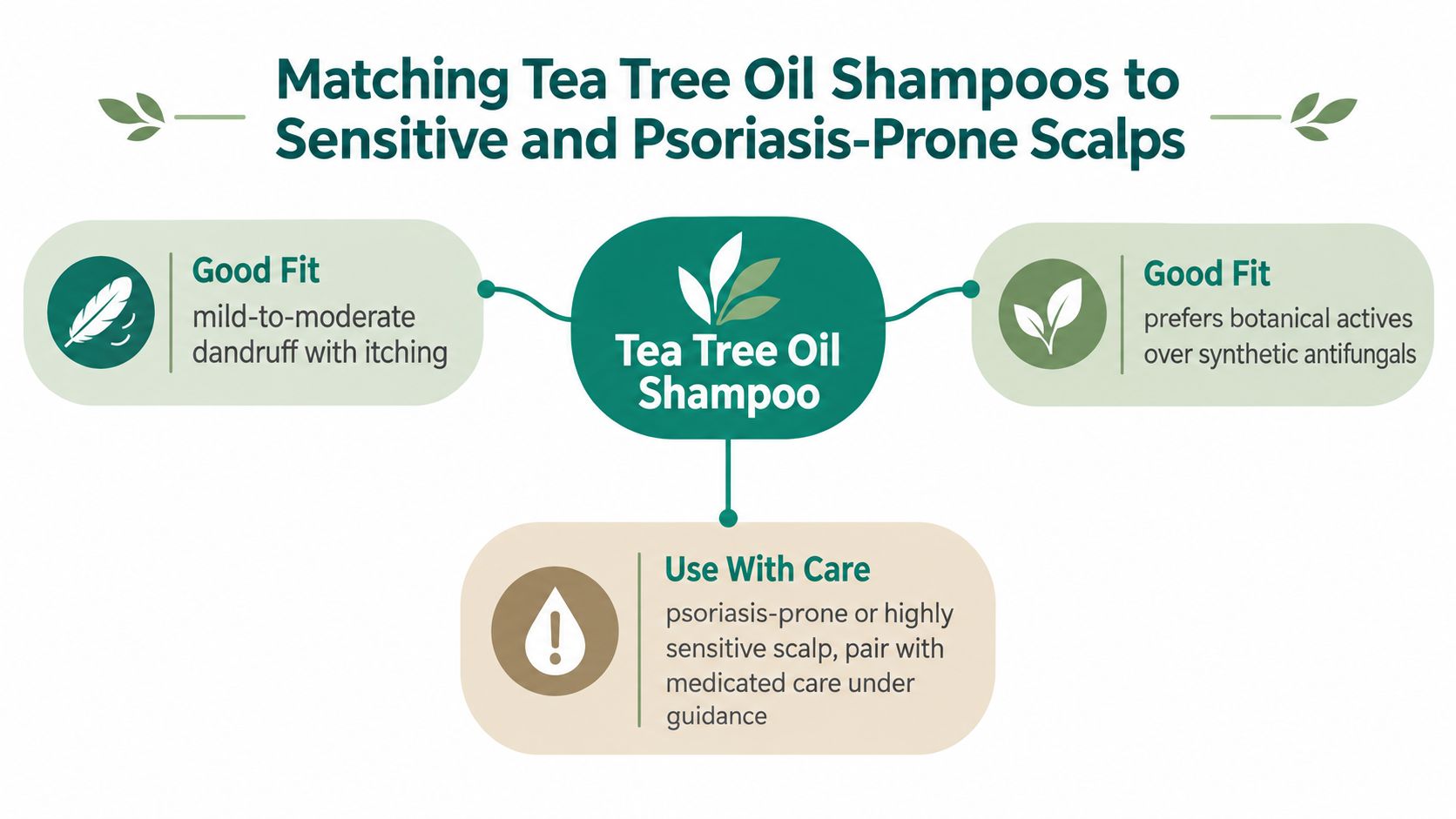
A tea tree shampoo is a good fit when you have mild-to-moderate dandruff with itching, or when you prefer botanical actives and want something you can keep in rotation. It can also work as maintenance between stronger washes, especially if your scalp improves but doesn't stay perfect on its own.
For seborrheic dermatitis, tea tree oil is usually better understood as adjunct care. It may help with comfort and flaking, but persistent redness, greasy scale, or recurring irritation often needs a more direct treatment plan.
For psoriasis-prone scalps, the priority is different. Thick plaques and stubborn scaling usually need proper diagnosis and, in many cases, keratolytic or corticosteroid treatment first. For psoriasis-prone scalps, tea tree oil shampoos should be viewed as scalp-care products rather than a replacement for appropriate psoriasis treatment.
A simple fit guide
- Good fit: Mild dandruff, routine maintenance, botanical preference.
- Use with care: Reactive, dry, or fragrance-sensitive scalps.
- Pair with guidance: Psoriasis-prone scalps or long-running seborrheic dermatitis.
If your scalp is very sensitive, the safest path is usually the least aggressive one that still works. That means a low-irritation base, a modest tea tree level, and alternating with a bland cleanser when needed.
The internal guide on scalp soothing shampoo is relevant here because it helps separate “soothing” formulas from shampoos that only sound gentle.
Common Misconceptions About Anti-Dandruff Shampoos With Tea Tree Oil
A lot of people assume more tea tree oil means better results. That's not how scalp formulas work.
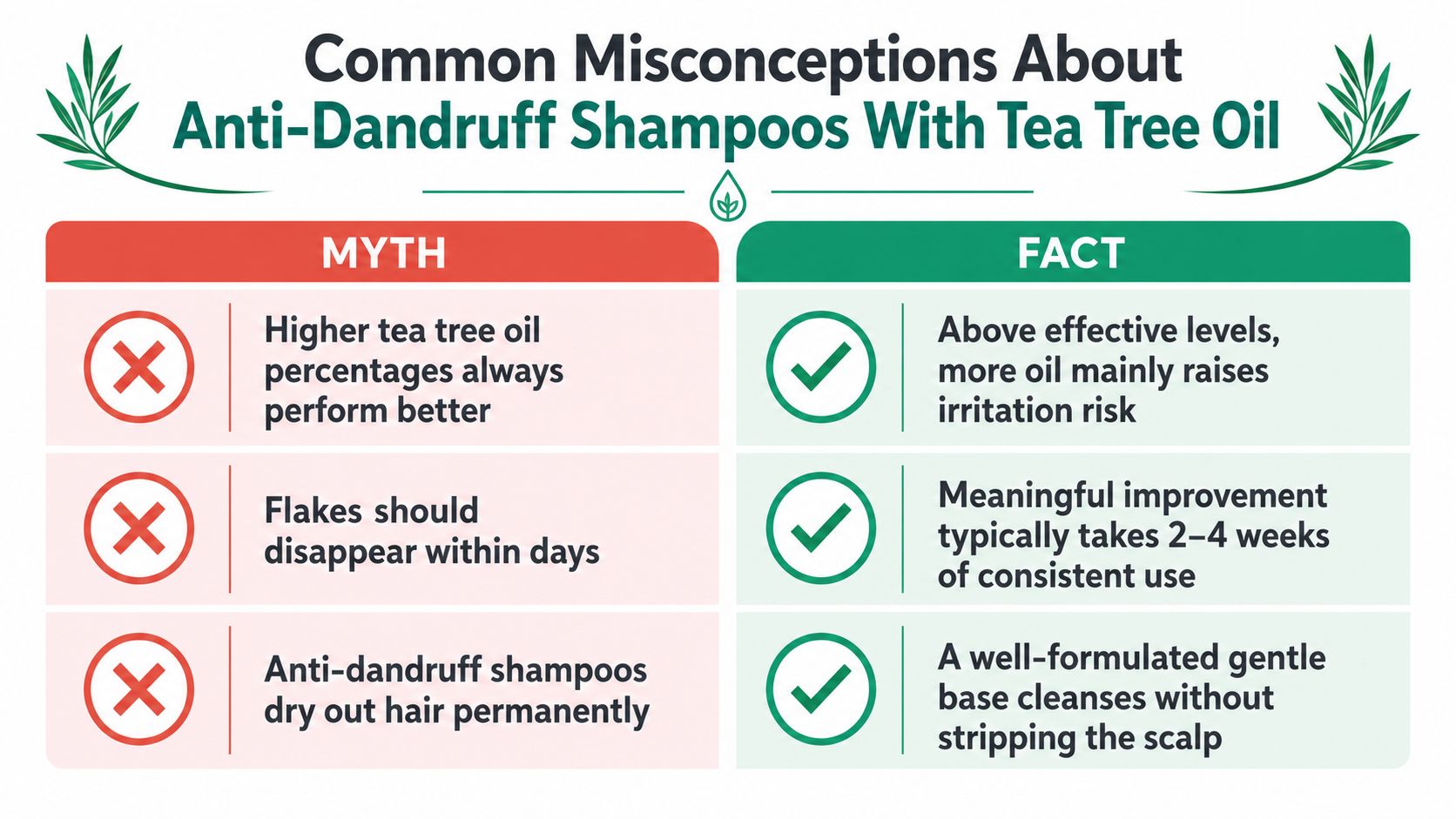
Myth versus fact
-
Myth: Flakes should disappear in a few days.
Fact: Visible improvement usually needs consistent use over time, because the scalp has to calm down and shed in a more normal pattern. -
Myth: Natural means harmless.
Fact: Tea tree oil can still irritate skin, especially if the scalp is already dry, inflamed, or eczema-prone.
Tea tree oil is also not the same thing as a strong antifungal shampoo. It has antimicrobial and soothing qualities, but when dandruff is severe, the more established medicated actives often need to come first.
Patch testing is still smart, even for people who've used botanical products before. Sensitive scalps don't care whether an ingredient comes from a plant or a lab, they care whether it stings.
If a shampoo makes your scalp burn, itch harder, or turn red after repeated use, stop treating that as a normal adjustment phase. That's your signal to switch formulas or get a dermatologist involved.
Final Takeaway and What to Do Next
An anti dandruff shampoo with tea tree oil makes the most sense when you want a moderate, scalp-friendly option and you're willing to use it consistently. The label should tell you the active level, the cleansing base should feel gentle enough for a flaky scalp, and the routine should give the shampoo enough time to work without over-washing the skin barrier.
If you're comparing bottles on the shelf today, read them in this order, concentration, cleanser base, support ingredients, then your own scalp type. That simple filter will save you from buying on scent alone.
If your flakes are mild and your scalp just needs a calmer routine, a tea tree shampoo may be enough. If the scaling is stubborn, painful, or tied to psoriasis or seborrheic dermatitis, use tea tree as one part of a broader plan, not the whole plan.
If you want to compare formulas with more context, check the ingredient list, note how often you can realistically use the shampoo, and choose the bottle you'll keep using. If you're ready to narrow it down, open the label on the next tea tree shampoo you see and judge it with the same checklist you'd use for a formula review, that's the fastest way to pick a bottle that fits your scalp instead of your wishlist.