

You've noticed white flakes on a dark shirt, an oily patch near the roots, or a scalp that feels tight and uncomfortable after washing. Tea tree oil often appears in search results at exactly that moment, presented as a simple answer to several different scalp concerns. A useful tea tree hair & scalp treatment starts with a more careful question: what was studied, what format is safest, and what does your scalp need right now?
Tea tree oil can fit into a sensible routine, especially in a formulated rinse-off shampoo. It isn't automatically suitable for every scalp, and ingredient research shouldn't be confused with proof that every tea tree product will produce the same result. The practical approach is to use a well-formulated product consistently, watch for irritation, and seek professional advice when symptoms don't behave like ordinary flaking.
Why Tea Tree Oil Shows Up in Scalp Care Routines
Tea tree oil comes from the leaves of Melaleuca alternifolia, a plant native to Australia. It has become a familiar ingredient in shampoos, scalp cleansers, and cosmetic treatments because people often associate it with a fresh, cooling feel and use it when their scalp looks flaky, feels greasy, or seems uncomfortable.
Those symptoms can have different causes. Dandruff may involve larger or oily-looking flakes, while a dry scalp may produce smaller, white flakes alongside tightness. Product residue, frequent washing, weather, hair texture, and sensitivity to an ingredient can also change how the scalp feels and looks. Tea tree oil shouldn't be treated as a universal explanation or a cure for every scalp condition.
What tea tree oil can realistically offer
Tea tree oil has been studied for scalp comfort and visible flaking when it's used in a formulated product. One small clinical study examined a formulated rinse-off shampoo. It does not establish a target concentration for shoppers or mean every tea tree product will produce the same result. This is not a recommendation to seek a particular percentage or to apply concentrated oil directly to the scalp.
That distinction matters. A shampoo combines an active ingredient with cleansing agents and other formulation components, then gets rinsed away. A bottle of concentrated essential oil behaves differently on skin, particularly when the skin is scratched, dry, or already reactive.
A consistent routine also matters more than adding multiple strong steps. Gentle cleansing can remove excess oil and residue, while a suitable conditioner can help keep the hair lengths comfortable. Tea tree oil is one option within that routine, not a replacement for diagnosis when the scalp is persistently painful, intensely itchy, or visibly inflamed.
A useful mindset: choose tea tree oil for a specific cosmetic purpose, such as cleansing and helping manage visible flakes, rather than expecting it to solve every scalp problem.
People researching broader botanical routines may also benefit from this guide to essential oils for hair regrowth, but hair-growth discussions involve different questions from dandruff and scalp comfort. For a closer look at the ingredient itself, see tea tree oil benefits for hair and scalp care. Neither resource changes the central safety point: the formula and concentration matter as much as the ingredient name.
How to Use Tea Tree Shampoo for Scalp Care
A rinse-off shampoo is the most practical format for people who want to try tea tree oil without applying concentrated oil directly to the skin. The aim is to cleanse the scalp thoroughly without aggressive scrubbing or unnecessary exposure.
Build the routine around the label
Start with a product intended for scalp use. Check the directions, ingredients, and any warnings before applying it, especially if your scalp is sensitive or your hair is colour-treated. Don't assume that a product containing tea tree oil has the same composition as the clinical shampoo discussed later.
Use lukewarm water to wet the hair and scalp. Apply enough shampoo to distribute across the scalp, then use the pads of your fingers rather than your nails. A gentle massage helps spread the cleanser and loosen surface oil or residue without creating extra friction.
The product usually needs only the contact time stated on its label. Leaving shampoo on far longer doesn't automatically make it more effective, and vigorous rubbing can make a sensitive scalp feel worse. Rinse carefully until the hair and scalp no longer feel coated.
Adjust frequency to your response
People with a resilient, oily scalp may prefer regular use according to the product directions. If your scalp is dry, scratched, or sensitive-feeling, begin less often and observe how it responds before making the routine more frequent. Burning, increasing redness, stinging, or new itching are reasons to stop and reassess rather than push through.
Apply conditioner mainly to the lengths and ends if your roots become greasy easily. Keep your hands and tools clean, and avoid layering several fragranced or exfoliating scalp products at once while you're trying to identify what helps.
The tea tree shampoo scalp-care guide offers a related routine perspective. One relevant option is PsoriAid Shampoo with Tea Tree Oil & Peat, Relieves Itching & Redness on Psoriasis-Prone, Sensitive Scalp, Daily Use. According to its catalog description, it's a gentle daily shampoo formulated with Nordic peat mud and tea tree oil, free from harsh sulfates, and described as suitable for sensitive and colour-treated hair. Those product details describe the formula and intended cosmetic use, not evidence from the tea tree clinical trial.
Pre-Shampoo Serums and Leave-On Treatments Explained
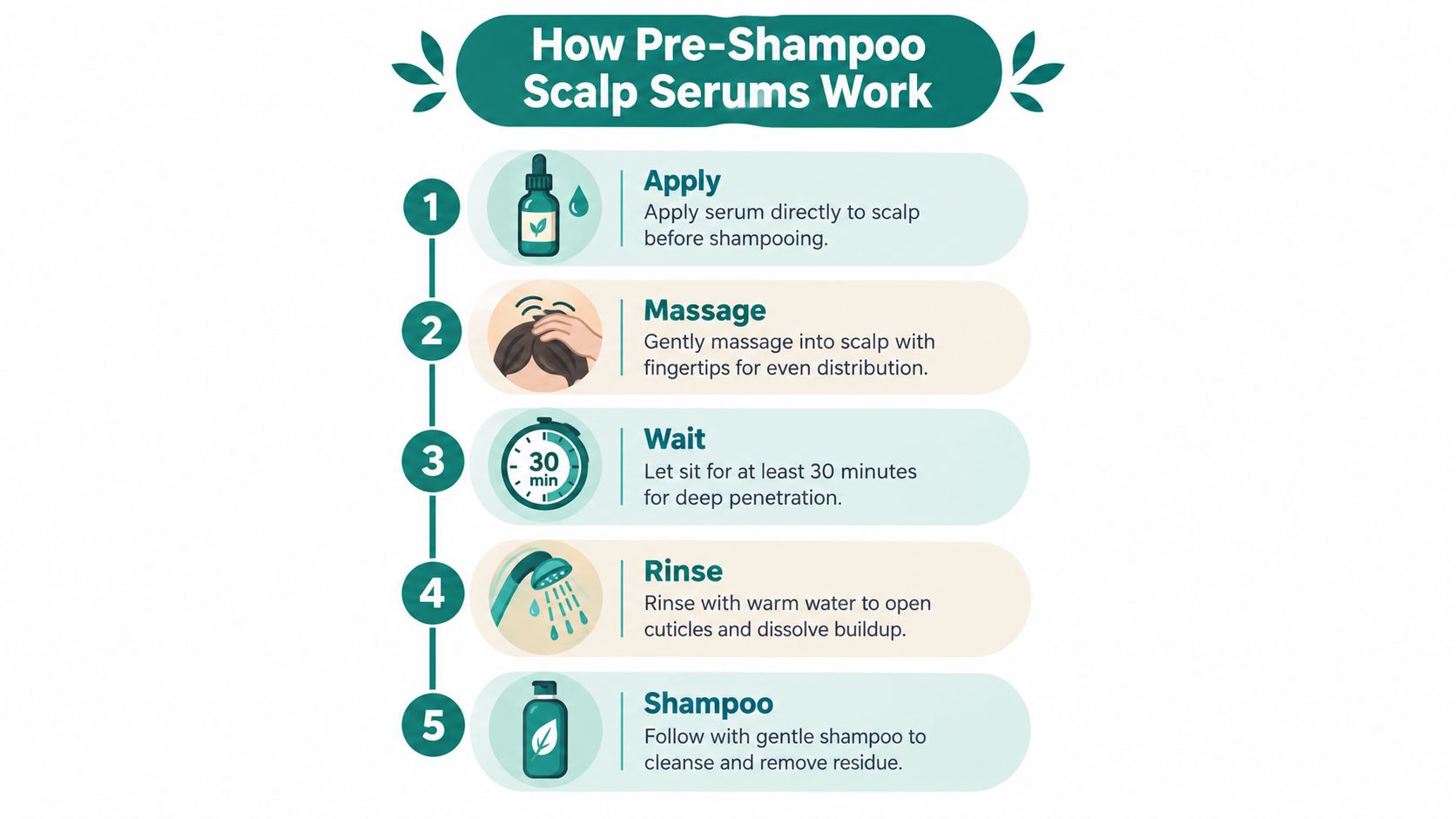
A shampoo and a pre-shampoo serum serve different practical roles. Shampoo is normally spread over the scalp and rinsed away after a short period. A pre-shampoo scalp serum is applied before washing, allowed to sit, and then removed during cleansing.
Comparing contact time and convenience
A pre-shampoo step can suit someone who wants to apply a small amount directly to the scalp before getting into the shower. The product can remain in place for approximately 20 to 30 minutes before shampooing, following its directions. That gives the formula more time on the scalp surface than a quick rinse-off wash, but longer contact doesn't automatically mean greater medical effectiveness.
Leave-on products also create more opportunity for irritation if the formula doesn't suit the user or if it's left on beyond the recommended period. This is especially relevant when the scalp has been scratched, feels raw, or reacts easily to fragranced products.
Choosing between one step and two
A shampoo alone is simpler. It may be the better choice if your scalp tolerates regular cleansing and you don't enjoy leaving products in before washing. A serum can be useful when you prefer a more deliberate pre-wash routine or want to apply a product to selected areas rather than the whole head.
For a pre-shampoo product, part the hair into sections and apply only the amount directed on the label. Massage lightly with fingertips, set a timer, and wash thoroughly afterward. Don't use a serum as permission to experiment with undiluted tea tree oil, kitchen mixtures, or several essential oils together.
The PsoriAid Pre-Shampoo Scalp Serum is positioned as a pre-wash scalp-care step and can remain on the scalp for approximately 20 to 30 minutes before shampooing. That format differs from shampoo because the serum sits on the scalp before cleansing. It doesn't mean that leaving it on longer will produce a better result, so follow the approved product directions.
What the Clinical Evidence Actually Shows
The most useful human evidence comes from a randomized, single-blind, parallel-group study published in 2002. It included 126 people aged 14 and older with mild to moderate dandruff. Participants used either a 5% tea tree oil shampoo or a placebo daily for 4 weeks, and the researchers assessed several dandruff-related outcomes. That percentage describes the study product; it is not a concentration recommendation for shoppers. (PubMed study record)
What changed during the trial
The tea tree shampoo group showed a 41% improvement in the quadrant-area-severity score, compared with 11% in the placebo group. Statistically significant improvements were also reported for total area of involvement, total severity, itchiness, and greasiness. The study reported no adverse effects in its summary.
A later medical review presented the whole-scalp lesion scores in another way. The tea tree group moved from a baseline score of 91.0 to 53.0 after four weeks, while the placebo group moved from 99.7 to 88.2. The review also reported an improvement in itchiness of 23% for tea tree shampoo versus 12% for placebo. (American Academy of Family Physicians review)
These results support a careful conclusion. Tea tree oil, when used in the studied shampoo formulation, showed measurable improvement in several dandruff-related signs compared with placebo. They don't prove that every tea tree shampoo works in the same way, and they don't establish that pure tea tree oil is appropriate for direct scalp application.
Why expectations need to stay realistic
The trial was relatively specific. It studied one concentration, one rinse-off product format, one daily-use schedule, and a defined group of people with mild to moderate dandruff. Real-world users may have a different scalp condition, a different product formula, or a sensitivity that wasn't represented in the same way.
Complete clearance was also uncommon. Only one patient in each arm became dandruff-free during the trial, so a month of use shouldn't be treated as a promise of total removal. The more honest expectation is gradual management of visible flakes and related discomfort, with reassessment if the scalp remains troublesome.
Safety, Sensitivity, and Common Mistakes to Avoid
Natural origin doesn't guarantee that an ingredient will feel gentle on every scalp. Tea tree oil can cause irritation, particularly when it's concentrated or used on skin that's already compromised by scratching, dryness, or a previous reaction.
Avoid improvised concentration
Avoid adding concentrated tea tree oil at home to shampoo, conditioner, or water. A broader safety review notes that tea tree oil is generally regarded as safe, but mild burning, stinging, itching, or contact dermatitis can occur in some users. (Mayo Clinic tea tree oil safety guidance)
European regulatory guidance also illustrates why concentration deserves attention. The Federal Institute for Risk Assessment recommends a maximum of 1% tea tree oil in cosmetic products, while the EU SCCS opinion allows up to 2.0% in shampoo and 1.0% in shower gel or face wash. (Federal Institute for Risk Assessment document)
These recommendations don't mean that every product at a lower concentration will suit every person. They do show why a standardized cosmetic formula is preferable to guessing how much essential oil to add to shampoo, conditioner, or water.
Patch-test and respond early
Patch-testing can help identify a reaction before you use a product across the scalp, although it can't guarantee complete protection from later irritation. Follow the product's own directions, and don't test on broken skin.
Stop using the product if you notice worsening discomfort, rash, swelling, or persistent burning. Seek medical advice when symptoms are severe, painful, rapidly worsening, infected-looking, or persistent, particularly if scaling extends beyond the scalp or the hair is shedding noticeably.
Sensitivity deserves respect: a product that feels refreshing to one person can sting another person's already-irritated scalp.
Don't expect complete clearance after a short trial, and don't keep increasing exposure because the first use didn't produce an immediate change. For additional context about essential oils and uncomfortable skin sensations, see this discussion of essential oil use for skin itching. Cosmetic scalp care can support comfort, but it shouldn't replace reliable medical treatment for an inflammatory or other diagnosed skin condition.
Frequently Asked Questions About Tea Tree Scalp Care
Can tea tree shampoo be used alongside a medicated shampoo?
It may be possible, but combining products can increase dryness or irritation. Ask a pharmacist or healthcare professional how to space them, and follow each label rather than layering several active treatments at once.
How quickly should I expect a change?
The clinical evidence involved daily use over four weeks, but individual responses vary. Look for a gradual change in visible flakes, greasiness, or comfort rather than expecting an instant result.
Is it suitable for colour-treated hair?
Some formulas are described as suitable for colour-treated hair, but check the specific product label. Hair-colour needs and scalp tolerance are separate questions.
When should I seek professional advice?
Get medical guidance for a painful, rapidly worsening, infected-looking, or persistent scalp problem. A clinician can help distinguish dandruff from dry skin, contact irritation, seborrheic dermatitis, psoriasis, eczema, or another cause.
Choose a formulated tea tree shampoo or clearly labeled pre-shampoo treatment, patch-test when appropriate, and follow the stated directions instead of applying undiluted oil. If your scalp remains painful, increasingly irritated, or unchanged despite a careful routine, contact a healthcare professional. For a gentle daily cleansing option, review the formula and usage guidance for Sphagnum Botanicals' tea tree and peat shampoo before deciding whether it fits your scalp-care needs.